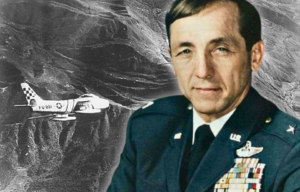
James Robinson “Robbie” Risner was a highly skilled U.S. military pilot, a double recipient of the Air Force Cross, and a hero of both the Korean and Vietnam Wars. Since he was a child, he had dreamed of flying, and the U.S. Air Force gave him the opportunity to turn that dream into reality. Throughout his long career, Risner not only demonstrated his exceptional skills as a pilot but also showed unwavering dedication to his fellow service members, even when it required great personal sacrifices.
James Risner’s early life

James Risner was born into a poor Arkansas family on January 16, 1925. His childhood brought plenty of hardships, and he began earning money while still young to help his family make ends meet. After the family relocated to Oklahoma, Risner continued working throughout his youth. By the time he reached high school, he had already held a string of jobs, from delivering newspapers and running errands to working in a drugstore, welding, and polishing vehicles at his father’s used-car business.
Risner developed a deep interest in horses and motorcycles as a young man, and both would go on to play an important role in his life. Religion was also a significant part of his upbringing, with his family regularly attending the 1st Assembly of God Church.
Enlistment in the US Air Force

James Risner enlisted in the US Army Air Forces (USAAF) in 1943 and finished his training the following year with the rank of second lieutenant. After flight school, he was transferred to Panama as part of the 30th Fighter Squadron.
In 1946, while pursuing his passion for motorcycles, Risner had an off-duty accident, which landed him in a military hospital. It was there he met Kathleen Shaw, a nurse who took care of him. The two were discharged and got married soon after. In civilian life, Risner didn’t have much luck in keeping a job. He joined the Oklahoma Air National Guard, piloting a North American P-51 Mustang to keep himself in flying shape.
On one occasion, Risner became caught in a hurricane. He was forced to land and only later realized he was in Mexican territory. He had a brief encounter with bandits, which ended well for him, and managed to return to the United States. While he earned himself an unofficial rebuke from the American Embassy for flying an armed fighter into a foreign country’s sovereign territory, the flight was officially ignored, for diplomatic reasons.
Recalled to active duty at the start of the Korean War
When the Korean War broke out, James Risner was happy to rejoin the US Air Force. He got recalled to active duty in February 1951, attached to the 185th Tactical Fighter Squadron and subsequently trained to fly the Lockheed F-80 Shooting Star, the first operational jet fighter developed by the United States. While designed for use in World War II, it was actively flown over Korea.
On his last day before being deployed overseas, Risner fell off a horse and broke his arm – once again, faith had interfered with his passion. However, he didn’t let the injury stop him from seeing action. He concealed it and convinced a surgeon it had healed – an ingenious tactic that allowed him to fly his first combat mission.
Participating in his first missions in Korea

On May 10, 1952, James Risner was assigned to Kimpo Air Base with the 15th Reconnaissance Squadron. That June, the 336th Fighter-Interceptor Squadron was looking for experienced pilots and Risner found an opportunity to finally fly a fighter and participate in combat. He became known for his North American F-86E Sabre, which featured Bugs Bunny as its nose art. The aircraft was nicknamed Ohio Mike, and Risner flew his most successful missions in it.
At first, Risner saw no combat and took a three-day leave to Japan. Upon his return to Korea, he jumped into an aircraft, as there were reports of MiG activity in the area. Four F-86s were under attack by 14 Mikoyan-Gurevich MiG-15s. He flew to their aid and managed to down one enemy aircraft.
This was his first aerial victory.
James Risner becomes ‘John Red Lead’

On September 15, 1952, James Risner flew an escort mission under the call sign “John Red Lead.” His assignment was to protect Republic F-84 Thunderjets conducting an attack on a chemical facility located along the Yalu River near the East China Sea.
During the mission, Risner passed over Antung Airfield and engaged a MiG in combat at extremely low altitude and nearly supersonic speed. Following a dry riverbed and skimming over low ridges, he chased the enemy aircraft to an airfield roughly 35 miles inside Chinese territory. The MiG pilot radioed ahead to warn others about the approaching American fighter, and within moments Chinese anti-aircraft batteries opened fire. Risner managed to evade the barrage as best he could and continued the pursuit.
Although his ammunition supply was running dangerously low, Risner held his fire until the right opportunity presented itself. He then unleashed his remaining .50-caliber rounds, tearing into the MiG. The attack blew off the aircraft’s canopy and set it ablaze. Risner subsequently shot it down between Chinese hangars, where the wreckage crashed into parked MiGs and destroyed them.
After the mission, fellow flight member 1st Lt. Willard P. Dunbar stated that the MiG pilot was an impulsive Russian aviator who shook his fist defiantly at Risner just before the aircraft went down.
James Risner continues his heroics in Korea

On their way back to base following his action, James Risner and his fellow airmen were flying above open water. Anti-aircraft fire hit 1st. Lt. Joseph Logan’s aircraft, and Risner attempted to get them back to base by pushing the nose of his own aircraft into the tailpipe of Logan’s, while his jet was floating in the air with its engine turned off.
The plan was to push Logan close to the island of Ch’o Do, where the US Army kept a helicopter outpost. However, Risner’s vision over the scene was heavily obscured by jet fuel and hydraulic fluid spewing out of Logan’s aircraft, forcing him to break contact.
Logan had to bail out. Just before he did, he radioed to Risner, “I’ll see you at the base tonight.”
While he managed to eject fairly close to the shore of Ch’o Do and was a solid swimmer, Logan became entangled in his parachute and drowned. Risner shut down his own engine in an attempt to save fuel, but his engine flamed out and he glided to a dead-stick landing at Kimpo Air Base.
Soon after this operation, Risner became a fighter ace, downing his fifth MiG. By the end of his service in Korea, he’d flown 108 combat missions and shot down eight enemy aircraft.
Captured in Vietnam

After Korea, James Risner headed to Vietnam, where he established himself as one of the leading pilots in the US Air Force by downing even more enemy aircraft.
Unfortunately, on one mission, his Republic F-105 Thunderchief was shot down. He was held prisoner in Hanoi for seven years and four months, during which time he was viewed as his captors’ “prized prisoner,” due to a Time article that highlighted his heroics. This, paired with his rank, meant he was subjected to harsher treatment than others.
Not only did Risner survive the experience, but he also helped others survive it, too. Among the men captured in Hanoi were Capt. James Stockdale, who later became a vice admiral in the US Navy. Another prisoner of war (POW), Cmdr. Everett Alvarez, Jr., later noted, “We were lucky to have Risner. With (Captain James) Stockdale we had wisdom. With Risner we had spirituality.”
Risner was promoted to colonel after his capture, and he was part of the first group of prisoners released on February 12, 1973, as part of Operation Homecoming.
James Risner returns to the United States

In July 1973, the US Air Force assigned James Risner to the 1st Tactical Fighter Wing at MacDill Air Force Base, Florida, where he learned to fly the McDonnell Douglas F-4 Phantom II in combat. He was later transferred to Cannon Air Force Base, New Mexico, to command the 832d Air Division, which flew the General Dynamics F-111 Aardvark.
Risner was promoted to the rank of brigadier general in May 1974. The following year, he became vice commander of the Tactical Fighter Weapons Center at Nellis Air Force Base, Nevada, before becoming commander of the Red Flag combat training program. He retired in August 1976.
More from us: William Goines: The First African-American US Navy SEAL Served Three Tours in Vietnam
Upon Risner’s death in October 2013, Gen. Mark A Welsh III stated, “Brig. Gen. James Robinson ‘Robbie’ Risner was part of that legendary group who served in three wars, built an Air Force, and gave us an enduring example of courage and mission success… Today’s Airmen know we stand on the shoulders of giants. One of ‘em is 9 feet tall… and headed west in full afterburner.”