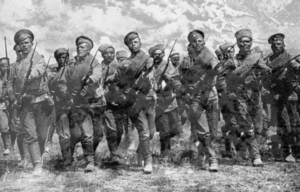
On August 6, 1915, German forces unleashed a dense wave of chlorine gas against Russia’s Osowiec Fortress, convinced the poisonous cloud would annihilate the defenders and open the path for capture. The gas rolled through the fort in a sickly green haze, triggering choking fits, blindness, and panic among the Russian troops caught in its path.
Assuming no one could have survived, German infantry moved forward to claim the position. Instead, they were confronted by a scene straight out of a nightmare. From the drifting fumes staggered Russian soldiers—uniforms torn, faces bound in blood-soaked rags, lungs burned by gas yet bodies still moving. Coughing blood and barely alive, they fixed bayonets and surged into a counterattack.
The shock was overwhelming. Convinced they were facing the living dead, the German troops broke ranks and fled in chaos. This moment, later known as the Attack of the Dead Men, became one of the most haunting episodes of World War I. Although many of the defenders later succumbed to their wounds, their last stand transformed what should have been a rout into a lasting testament to resilience, defiance, and sheer human will.
Chemical warfare during World War I

Chemical warfare made its debut on the battlefield during the onset of the Second Battle of Ypres during the First World War. The engagement was fought for control of a crucial strategic area, and the Germans were determined to secure victory, even if it meant resorting to the use of a perilous and somewhat uncontrollable weapon.
At around 5:00 PM on April 22, 1915, German soldiers unleashed canisters containing a deadly mixture of poison gases, bromine and chlorine. The noxious fumes drifted across the battlefield toward the Allied line, compelling two colonial French divisions to abandon their positions in a desperate attempt to escape the lethal vapor. With no specialized equipment to counter the attack, troops were forced to fashion makeshift respirators from linen.
As a result of this battle, the British withdrew to a new defensive line. Soon after, poison gas became a familiar presence on the Western Front, despite being deemed a war crime under both the 1899 Hague Declaration Concerning Asphyxiating Gases and the 1907 Hague Convention on Land Warfare. Both sides resorted to its use and continued to refine the types of gases deployed, with the British using gas for the first time during the Battle of Loos in September 1915.
Among the most notorious gases used during the war was mustard gas, which made its battlefield debut in July 1917. While not as immediately lethal as chlorine, mustard gas had the sinister quality of being heavier than the surrounding air, allowing it to linger and cause harm long after its initial deployment, persisting in the soil for weeks. Its effects were savage, inflicting severe injuries upon the unlucky soldiers who came into contact with it, with the pain being described as unbearable.
Osoweic Fortress

Launching the Battle of Osoweic Fortress

Kaiser Wilhelm II was intent on knocking Russia out of the war and set his sights on seizing Osowiec Fortress to achieve this goal. In August 1915, he dedicated significant military resources to the effort, placing the operation under the command of Field Marshal Paul von Hindenburg. Hindenburg led a formidable force and was accompanied by 14 infantry battalions, a sapper battalion, 30 artillery batteries, and approximately 24 to 30 massive siege guns.
In stark contrast, the Russian garrison defending the fortress numbered only about 900 men, while German forces swelled to an estimated at 7,000 troops—stacking the odds heavily against the defenders. Still, Osowiec Fortress had earned a reputation for its toughness, and the Russian soldiers took heart in their stronghold’s track record of survival. Yet this time, they would face a terrifying new weapon—poison gas—designed specifically to break even the staunchest resistance.
Deploying chlorine gas on the battlefield

Paul von Hindenburg’s plan bore little resemblance to a traditional siege, instead unfolding as a carefully engineered chemical attack. German forces arranged thirty chlorine-filled cylinders to discharge simultaneously, relying on a favorable wind to carry the poison straight toward Osowiec Fortress. In the pre-dawn hours of August 6, 1915, the moment arrived, and the assault was unleashed.
The landscape was quickly overtaken by terror. A thick, yellow-green cloud rolled forward, killing vegetation and burning the lungs and skin of anyone trapped in its path. Soldiers who recognized the drifting gas understood its grim promise—intense agony and, for many, death. Inside the fortress, the Russian garrison had almost no real protection. Struggling to breathe, men clutched wet cloths or urine-soaked rags to their faces in a desperate attempt to blunt the fumes. The improvised defense offered little relief, yet the defenders held on, steeling themselves for a response that would shock friend and foe alike.
Attack of the Dead Men

What happens when chlorine gas is inhaled? It combines with the body’s moisture to produce hydrochloric acid. Essentially, the Russians were being consumed from within by the very air they breathed. With such a deadly weapon, it seemed their fate was sealed. Many perished due to Paul von Hindenburg’s ruthless tactic, but they were far from defeated, as the Germans were about to discover.
Lt. Vladimir Kotlinsky was unwavering in his mission to drive back the enemy. He and 60 other men suffered horribly, wrapped in blood-soaked bandages and coughing up bits of their lungs as the acid ravaged their bodies. Yet, they still charged at the Germans as they breached the fortress.
It became a slaughter—but for the Germans. From the perspective of the Kaiser’s elite, they were facing what seemed like an army of the undead. The sight was so horrifying that they retreated in terror. Some were so overwhelmed with fear that they ran straight into barbed wire.
What happened to Osoweic Fortress after the Attack of the Dead Men?

Osoweic Fortress fell following the Attack of the Dead Men, but not by German hands. The Russians later took it apart themselves that month, when they realized the situation was hopeless. The soldiers that day managed to cheat death, if only briefly, to repel the enemy and maintain their might for as long as humanly possible.
While he’d led a fierce resistance against the Germans, Vladimir Karpovich perished later that evening. Prior to his death, he’d transferred control of Osoweic Fortress to the 2nd Osovetska Sap Company and Władysław Strzemiński, who himself had been severely injured in the attack.