In August 1972, U.S. magnetic sea mines deployed off the coast of North Vietnam unexpectedly exploded in large numbers despite the absence of any confirmed enemy ships in the vicinity. American records described numerous underwater detonations, and some accounts estimate that as many as 4,000 mines may have been activated during the incident.
Subsequent investigations connected the event to an intense period of solar activity. Researchers concluded that disturbances in Earth’s magnetic field caused by solar activity likely affected the mines’ magnetic sensors, triggering the widespread detonations.
Historically powerful solar storms
Solar flares are violent storms on the Sun’s surface which can eject particles and emit radiation toward Earth. (Photo Credits: National Optical-Infrared Astronomy Research Laboratory (NOIRLab) / Wikimedia Commons CC BY 4.0).
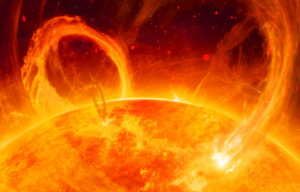
In August 1972, one of the most powerful solar storms ever recorded occurred. That month, the Sun had displayed increased solar activity before unleashing a series of extremely powerful solar flares – intense eruptions of radiation caused by the interactions of powerful magnetic fields within the star.
The burst of energy from a solar flare can be followed by a coronal mass ejection (CME), a magnetic cloud of radioactive particles that’s expelled from the Sun into the cold expanse of interplanetary space at unfathomably high speeds. While the Sun is almost 93 million miles away from the Earth, normal CMEs can make the journey in just one or two days.
The most intense solar flare of the August 1972 storm sequence erupted on August 4, launching a highly energetic coronal mass ejection packed with radiation into space. The ejected material arrived at Earth in just 14.6 hours, establishing a record for the fastest known transit of a coronal mass ejection to Earth—a milestone that still stands today.
Upon reaching the planet, the storm produced a severe disruption of Earth’s magnetosphere. The resulting geomagnetic activity generated auroras that extended well beyond their usual latitudes, with sightings reported as far south as Spain. The influx of charged particles also saturated scientific instruments, causing readings to spike dramatically and driving some magnetometers beyond their normal measurement ranges.
Such powerful solar events can have significant consequences for spacecraft and satellites. Increased radiation levels and electrical effects can damage onboard systems, and one satellite was reportedly subjected to degradation comparable to about two years of normal operational wear during the course of the storm.
The event attracted particular interest because it occurred in the interval between the Apollo 16 and Apollo 17 missions. Had astronauts been traveling to the Moon or working on its surface when the storm reached its peak, they might have received hazardous amounts of radiation, with exposure during a spacewalk potentially reaching life-threatening levels.
Sea mines detonated off the coast of Vietnam
Photo Credit: Melia, Tamara Moser, “Damn the Torpedoes”: A Short History of U.S. Navy Mine Countermeasures, 1777-1991, Washington, D.C.: Naval Historical Center, 1991 / United States Navy / Wikimedia Commons / Public Domain
American magnetic sea mines laid off the coast of northern Vietnam were designed to explode when they detected the magnetic field produced by passing ships. Equipped with sensors that constantly measured changes in the surrounding magnetic environment, the mines would detonate whenever a vessel entered their detection range. They were deployed as part of Operation Pocket Money, a campaign intended to block maritime trade along Vietnamese coastlines.
In August 1972, powerful solar storms disturbed Earth’s magnetic field enough to set off many of the mines even though no ships were nearby. Although the U.S. military understood that solar activity could affect systems on Earth, it had not anticipated that the disturbances would be strong enough to trigger the mines.
New appreciation for the August 1972 solar storms
Photo Credit: E. Gibson / MPI / Getty Images
In 1972, the strange happenings caused by the enormous coronal mass ejection were seen as unremarkable and mostly fell under the radar of researchers at the time. It wasn’t until Delores Knipp, an esteemed research professor at the University of Colorado Boulder, began looking into the event that the true scale of the Sun’s activities back then was realized.
Knipp’s research began after a chance conversation with a colleague, who, at the time, was working at what would later become NOAA’s Space Weather Prediction Center. The latter had witnessed US Navy officials enter a meeting with his boss, and while he’d been unable to hear the details, he knew it was about a then-recent solar storm and its impacts on the military.
The 1972 solar storms are a warning about the power of the Sun
Photo Credits: David McNew / Getty Images
After learning about this, Knipp dived into military archives. She found a document that had been declassified in the 1990s that contained information about the spontaneous detonation of sea mines in Asia. With some more digging, she realized estimates made at the time significantly low-balled the power of the solar storm. She believes it was actually much closer in severity to the 1859 Carrington Event, the largest geomagnetic storm ever recorded.
Despite this, many failed to recognize its significance. “I think people forgot about it,” Knipp said in 2018. “They didn’t know about the sea mine problem and the effect on the power grids got published in engineering journals, not science journals.”