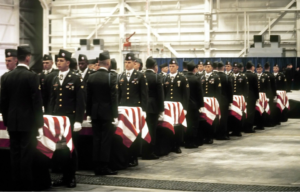

The plane crashes with members of the 101st Airborne onboard

Flight 1285R left Cairo, Egypt, at 8:35 PM on December 11, 1985, embarking on its journey back to the United States with planned refueling stops in Cologne, West Germany, and Gander, Newfoundland. The DC-8 landed in Cologne at 1:21 AM, where a brief stop included refueling and a crew change; eight new crew members joined before the aircraft departed slightly over an hour later.
The plane arrived at Gander International Airport at 9:04 AM on December 12. While ground crews refueled the aircraft and conducted external inspections, passengers were allowed to briefly disembark to stretch their legs. At 10:15 AM, the DC-8 taxied to runway 22 and began its takeoff, reaching 192 miles per hour. Witnesses later observed that the aircraft struggled to gain sufficient altitude, never attaining a safe height.
As the speed climbed to 198 miles per hour, the plane suddenly plunged, coming dangerously close to the nearby Trans-Canada Highway. Eyewitnesses reported a bright flash just before the DC-8 crashed near Gander Lake. The impact tore the aircraft apart and triggered a massive fireball, fueled by its full fuel tanks.
All 248 people on board—including 236 soldiers from the 101st Airborne Division and eight crew members—were killed instantly. At the time, it was the deadliest DC-8 accident on record, a grim distinction that lasted until Nigeria Airways Flight 2120 crashed in 1991. The disaster remains Canada’s worst aviation accident and the largest single non-combat loss in the history of the U.S. Army.
The Canadian Aviation Safety Board launches an investigation

Right after the plane crash, the Canadian Aviation Safety Board (CASB) dispatched a response team to collect evidence that could help them determine what had occurred. By the end of their investigation, five out of nine board members concluded that, as the DC-8 approached Gander, conditions were conducive to ice formation on the aircraft’s wings. The plane continued to be exposed to freezing precipitation upon landing and had not been de-iced before taking off for Kentucky.
Although the members couldn’t identify the precise sequence of events leading to the crash, they stated in their report that “the weight of evidence supports the conclusion that, shortly after lift-off, the aircraft experienced an increase in drag and reduction in lift that resulted in a stall at low altitude from which recovery was not possible.” They attributed the stall to ice contamination on the upper surface of the DC-8’s wings.
Four CASB members disagreed, suggesting instead that “an in-flight fire that may have resulted from detonations of undetermined origin brought about catastrophic system failures” causing the crash. They also pointed out shortcomings in the data retrieved. Judge Willard Estey of the Supreme Court of Canada later ruled that the evidence did not support either conclusion, leading to the CASB’s dissolution and the formation of the Transportation Safety Board of Canada.
On the day of the crash, an anonymous caller contacted a French news agency in Beirut, claiming responsibility on behalf of the Islamic Jihad Organization. However, both the Canadian and US governments dismissed this claim.
The plane crash had a lasting impact on the 101st Airborne

A few days after the tragic plane crash, President Ronald Reagan and First Lady Nancy Reagan visited Fort Campbell to offer support to the 101st Airborne Division and the grieving families. Addressing the crowd, Reagan said, “Some people think of members of the military as only warriors, fierce in the martial expertise, but the men and women we mourn today were peacemakers. They were there to protect life and preserve peace, to act as a force for stability and hope and trust.”
After the recovery efforts, the fallen soldiers were brought back to the United States, accompanied by their fellow 101st Airborne comrades. Since the crash, several memorials have been established to honor the victims, including one overlooking Gander Lake, another at Fort Campbell, and a Memorial Park in Hopkinsville, Kentucky.
Each year, a memorial service is held in Gander to remember the 256 lives lost. The event is live-streamed to Fort Campbell, allowing current members of the 101st Airborne to take part in the tribute.
More from us: The Douglas SBD Dauntless Changed the Course of the Second World War In a Single Day
The crash of Flight 1285R has been explored in various television programs over the years. Unsolved Mysteries aired an episode suggesting possible links to the Iran-Contra Affair, speculating that an explosion, detonation, or fire may have caused the crash. The Discovery Channel series Mayday also examined the incident in a season 11 episode titled “Split Decision.”