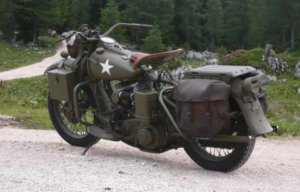
While motorcycles lacked the armor and heavy weaponry of most vehicles used during World War II, they were still widely utilized throughout the conflict. Their speed and maneuverability made them especially useful for dispatch riders, reconnaissance units, and communication roles in fast-changing battlefield conditions.
Below is a selection of nine motorcycles that saw frequent use on or near the front lines, featuring both German and American designs employed during the war.
FN M12

BMW R75

Development of the BMW R75 began in the late 1930s, at the request of the Wehrmacht. A large, heavy motorcycle, it was used heavily throughout WW2 by the Germans on both the Eastern Front and during the North Africa Campaign. The latter, with its dust and sand, resulted in a few changes to the design, including the change from metal fork covers to ones made from rubber.
Equipped with a sidecar, the BMW R75 was sometimes seen mounted with an MG 34 machine gun, giving it firepower similar vehicles didn’t have. While initially viewed as more of a “tow mule” by the German military, the motorcycle eventually was used by Kradschützen Truppen – mobile infantry forces within the Wehrmacht and SS.
Zündapp KS 750

Another notable German motorcycle from World War II, the Zündapp KS 750, had a hefty build and a design that closely resembled the BMW R75. Outfitted with a standard sidecar, it was difficult to tell the two apart, particularly since both served similar roles on the frontlines in North Africa, Italy, and the Eastern Front.
What set the KS 750 apart was its dual driven wheels—both the rear and the sidecar—providing enhanced traction. During the war, roughly 18,695 units were produced, and after the conflict, Zündapp continued production for the Finnish Army as well as the civilian market.
Type 97

Produced between 1935 and 1945, the Type 97—also known as the Rikuo—was a Japanese motorcycle used during World War II. It was a copy of a Harley-Davidson design, manufactured under agreement with the American company. The motorcycle was operated by the Imperial Japanese Army, particularly for duties within the home islands.
While the Type 97 was the most common version, it was not the only model used. A sidecar-free variant known as the Type 93 was also produced during the wartime years by the Sankyo Corporation, expanding the range of motorcycles available to Japanese forces.
Welbike

A rather unusual sight on the battlefield, the Welbike, manufactured by Excelsior Motor Company, was a foldable motorcycle used by the British Army during WW2. Commissioned by the Special Operations Executive‘s (SOE) Station IX (“Inter Services Research Bureau”), the aim was to provide airborne troops with a vehicle that could be dropped from a parachute and easily transported.
While equipped by the British 1st and 6th Airborne Divisions during Operation Market Garden, the Welbike definitely wasn’t a preferred mode of transportation. This is because it could carry no equipment, was almost useless off-road and what wound up being a rather difficult transportation process, on the part of its parachute/shipping container.
By the end of the conflict, the Welbike was no longer being used for military purposes. Instead, it found its way onto the civilian market, due to its cheap design and portability on the ground.
Norton WD16H

The Norton 16H had been available since 1911, but World War II introduced a new variant: the WD16H. Norton Motorcycle Company was the chief manufacturer of this model for the British Army during the war, with their Birmingham factory producing up to 500 a week!
The WD16H gained popularity for its durability and reliability, even though it had modest performance capabilities. Primarily, the British Army utilized it as a solo vehicle for convoy management and dispatch duties, but it also saw a purpose in training and reconnaissance. Additionally, the Royal Air Force (RAF) modified the motorcycle with a sidecar, allowing it to carry two occupants.
Norton WD Big 4

Also known as the Norton 633, the WD Big 4 was essentially a more powerful version of the WD16H. Designed from the start to be fitted with a sidecar, it had a powerful 633cc engine and was known for how easy it was to maintain in the field.
While the sidecar was unarmored and made from thin sheet metal, it was designed in a way to allow for the mounting of such weapons as the Bren light machine gun or a three-inch mortar. It could also be used as a weapons platform for bombs if the situation presented itself.
While popular during WW2, the motorcycle was ultimately replaced by the Willys Jeep, which has since become synonymous with the military.
Cushman Airborne Scooter (Model 53)

While the Cushman Airborne Scooter didn’t make an appearance in the European Theater until the latter stages of WW2, it was a handy tool for Allied paratroopers – in particular, those from the United States.
The vehicles, powered by a single-cylinder engine, were manufactured beginning in 1944, with nearly 5,000 produced by the end of the conflict. Their primary use was to transport troops and weapons between positions, with protection coming in the form of the scooter’s ability to be mounted with either an 81 mm mortar or a .30-caliber or .50-caliber machine gun.
Harley-Davidson WLA

Arguably the most famous WW2-era motorcycle on this list, the Harley-Davidson WLA was equipped by the US Army throughout the conflict. Produced between 1940-52, it was more widely known by the nickname “the Liberator,” and while based on a civilian model did feature several changes, including its paint job, fenders, fording, accessories and air cleaner. It also had a second set of blackout lights to ensure safe travel in dark conditions.
While not initially designed to feature a sidecar, the variants used by the Soviet Red Army were adapted to feature one. The WLA was largely used for escort and police work by the US Army during WW2, with the motorcycle also being used for courier duties, scouting operations, courier duties and the transportation of radio equipment.
More from us: USS Kidd (DDG-100): The Only US Navy Warship That’s Allowed to Fly the Jolly Roger
Over the course of WW2, more than 90,000 were produced, with production restarting upon the outbreak of the Korean War.