When Los Angeles burned in January 2025, the frightening part wasn’t just the flames—it was the speed. Red Flag warnings were up, Santa Ana winds were forecast to howl (with mountain gusts predicted around 90 mph), and two major blazes—the Palisades and Eaton fires—erupted within hours. A year later, the tally still reads like a war bulletin: 31 lives lost, 59 square miles charred, and 16,246 structures destroyed.

And researchers are warning that fire-prone weather is showing up more often across the globe—conditions that make extreme fires more likely and also stretch firefighting resources when multiple regions burn at once.
Fire is a modern fear. But it was also a WWII strategy—so much so that the U.S. briefly explored one of the strangest incendiary concepts ever put on a government checklist: the Bat Bomb.
Fire Was The Point—Bats Were Just The Delivery System

To understand why anyone took “bombs on bats” seriously, you have to remember what planners knew about Japanese cities at the time: many homes and buildings used highly flammable materials, and incendiary attacks could spread fast once ignition started in the right places.
That grim logic culminated later in the war with devastating raids like Operation Meetinghouse (March 9–10, 1945), when incendiaries helped create catastrophic urban fires in Tokyo.
The bat bomb sat in that same “fire problem” lane—just with a delivery method that sounds like a comic-book pitch.
A Dentist, Carlsbad Caverns, And A Letter To The White House
The idea’s champion was Dr. Lytle S. Adams, a dentist from Irwin, Pennsylvania. According to a scholarly historical account, Adams had recently watched massive bat flights at Carlsbad Caverns—and on December 7, 1941, he heard the news of Pearl Harbor while traveling home. Soon after, he began pushing the notion that bats could carry tiny, timed incendiaries into Japan’s vulnerable building spaces.

The proposal made it far enough into the system that it became a real project—eventually known as Project X-Ray.
Project X-Ray: Intended to Start Thousands of Hidden Fires

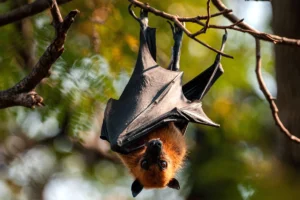
In the Air Force Test Center’s description, the concept was brutally simple: capture Mexican free-tailed bats, cool them into a dormant state, place them in a bomb-like canister, drop the container so the bats wake up, disperse, and roost—then let tiny time-delayed incendiaries (including napalm devices) ignite after they’ve tucked themselves into roofs, eaves, and attics.
The point wasn’t a single blast. It was to be many small fires in hard-to-reach places, all popping off around the same time—exactly the kind of ignition pattern firefighters hate.
The Test That Proved It Could Work… And Why Nobody Trusted It
One of the most famous trials came in 1943 near Carlsbad. The National Park Service recounts a test where bats revived sooner than expected, flew off, and obligingly roosted—in the base’s own control tower, hangars, offices, and barracks—carrying incendiaries with a 15-minute fuse. The result: facilities burning while stunned personnel watched.
That’s the bat bomb in a nutshell: it demonstrated real fire-starting potential, but it also showed the core flaw—a living carrier would never be as reliable as equipment.
Why The Bat Bomb Died On The Vine
Even accounts sympathetic to the project agree it was undone by practicality and priorities. By late 1944, Project X-Ray was canceled, as the U.S. funneled attention and resources toward other war-ending tools—most notably the atomic bomb program.
The bat bomb never reached combat. But as 2026 reminds us how fast fire risk can spike—and how hard it is to control once it runs—Project X-Ray stands as a weird, haunting footnote: a weapon concept built around the oldest terror in warfare, delivered by nature’s most unreliable couriers.