Console supercomputers
In 2002, Sony released a Linux kit for the PlayStation 2, which allowed the console to be used as a personal computer. This opened up the PS2 to researchers who wanted to use its processing power. Craig Steffen, a senior researcher at the National Center for Supercomputing Applications (NCSA), said, “They built the bridges so that you could write the code, and it would work.”

Steffen was on a team in 2002 that tried to make a supercomputer from a cluster of PS2s. 60–70 consoles were hooked up together, but unfortunately, the system was unreliable: “It worked okay, it didn’t work superbly well,” Steffen said. The system suffered from bugs that the team simply could not fix.
The team abandoned the project soon after. The PS3’s arrival marked one of the biggest generational jumps in performance in the history of gaming consoles. The PS3 brought 37 times the FLOPS offered by the PS2. FLOPS, or floating point operations per second, is a measure of computer performance. It is a good indicator of performance, although it’s not a foolproof way of measuring practical performance, similar to how cars with the same horsepower can be wildly different in terms of speed.
With the release of the PS3, which could also run Linux software reliably, researchers now had a stable, powerful system to work with.
Black hole researcher Gaurav Khanna from the University of Massachusetts Dartmouth recognized the PS3 as a potential tool for his work. Theoretical astronomy is heavily reliant on computer simulations, which naturally require enormous amounts of processing power to accurately simulate unfathomably complex astronomical objects like black holes. But this level of computing power is expensive.
Because this kind of research is not as impactful on society as other types like cancer research and technology, funding is usually scarce. Because of this, Khanna and his colleagues were looking for a cheap form of processing power, which they found in the PS3.
Well, actually a lot of PS3s — 176 of them in total.
While for the average gamer, the cost of 176 consoles is astronomical (pun intended), Khanna saved millions by using the PS3. They were able to use this machine to study black holes, crunch huge calculations and even win cryptography competitions.
The Air Force’s Condor Cluster
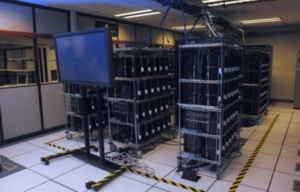
The U.S. Air Force, unconcerned with budget limitations, also created a supercomputer using PlayStation 3 consoles—this time deploying ten times the number used in Khanna’s project. Their system, named the Condor Cluster, consisted of 1,760 PS3 units linked together with roughly five miles of cabling. At its height, the cluster achieved a ranking as the 35th most powerful supercomputer globally.

The Condor Cluster wasn’t designed solely for raw computing power; it also served as a showcase for energy-efficient supercomputing. Thanks to the PS3 consoles’ efficiency, the cluster consumed only about 10% of the electricity that traditional supercomputers of similar capability required.
Delivering 500 teraflops (TFLOPS)—far surpassing the 16.2 teraflops of an NVIDIA RTX 8000 GPU—the system was employed by the Air Force to analyze extremely high-resolution satellite imagery.
Beyond image processing, the Condor Cluster could execute “learning” algorithms capable of reading text and accurately inferring missing information. This functionality proved invaluable for intelligence work, helping the Air Force reconstruct incomplete or fragmented documents.
More from us: Messerschmitt Built Tiny, Ridiculous Cars When Planes Weren’t An Option