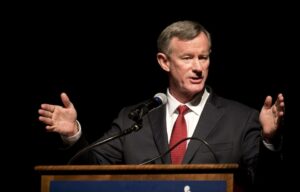
William McRaven is widely regarded as one of the most important leaders in the history of the Navy SEALs. Over the course of his career, he rose to become a four-star admiral and helped shape the organization and tactics of modern U.S. special operations. His most famous achievement came in 2011, when he oversaw the high-risk raid that killed Osama bin Laden—an operation that became a defining moment in the global war on terror.
But McRaven’s influence reached far beyond any single mission. Known for his strategic insight and decisive leadership, he played a central role in overhauling America’s special operations doctrine, emphasizing agility, accuracy, and close cooperation across agencies. When he retired in 2014, he left behind a transformed force—one guided by the principles of innovation, discipline, and professionalism that he championed throughout his career.
William McRaven’s upbringing

William McRaven’s path to a military career appeared to be set from the start. Born in Pinehurst, North Carolina, he spent his early years there while his father, Claude, was stationed at Pope Army Airfield. A World War II-era Spitfire pilot and former NFL player, his father likely had a significant influence on McRaven’s decision to pursue a military career.
While in elementary school, McRaven moved to Texas, where he became heavily involved in track and field. He later joined the Navy ROTC program and, in 1977, graduated from college with a Bachelor’s Degree in journalism.
McRaven’s early military career

After completing his college education, William McRaven began his military career by entering the Navy’s notoriously difficult SEAL training program. He made it through the rigorous course and, after a six-month evaluation period, secured his place within the elite community.
In the early 1980s, McRaven was stationed in Dam Neck, Virginia, where he worked under Richard Marcinko, the first commander of SEAL Team 6. The two clashed almost immediately, and McRaven was ultimately dismissed from the unit. Marcinko later described their contrasting styles by saying, “He was smart, but he couldn’t handle my rough edges. If I was unpredictable, he was overly strict. He removed the ‘special’ from special warfare.”
Despite the setback, McRaven’s career continued to advance. He later led a task unit during the Persian Gulf War and went on to earn a Master of Arts from the Naval Postgraduate School in 1993, further enhancing his expertise in strategy and leadership.
Broken in half

While McRaven was well on his way to a storied military career, it almost didn’t happen. He told NPR in 2019 about a ’01 training exercise where he was nearly killed after being hit in the air by another parachutist.
“I kind of tumble through the parachute. But I’m stunned,” he said. “I’m not exactly sure what’s happened. I don’t know whether I’ve been knocked unconscious. I don’t know whether I’ve been dazed. And now I’m tumbling out of control towards the ground.”
He continued, “Because I was tumbling, the pilot chute came out and wrapped around one leg, and then another part of the parachute called the riser came out and wrapped around my other leg. So now I am tangled up in my parachute, falling towards the ground. The good news is, as I fell a couple hundred feet or a thousand feet or so, the parachute finally opened. The bad news is, when a parachute opens, it blossoms.”
The accident resulted in a broken pelvis for McRaven. A few months later, 9/11 happened. At this time, he was still recovering from his injuries.
Operation Neptune Spear

In 2011, McRaven, who was then serving as a vice admiral in the US Navy and heading the Pentagon’s Joint Special Operations Command, received a pivotal briefing from CIA Director Leon Panetta. Panetta informed him that the agency had pinpointed Osama bin Laden’s location and tasked McRaven with leading the mission to eliminate him. Known for his expertise in planning and executing high-stakes covert operations, McRaven was given full authority to oversee the operation.
The operation culminated in success, with SEAL Team 6 carrying out the raid that led to bin Laden’s death on May 2, 2011. McRaven’s leadership and strategic brilliance earned him widespread recognition, and he was named a finalist for Time’s Person of the Year.
McRaven formally retired in 2014
