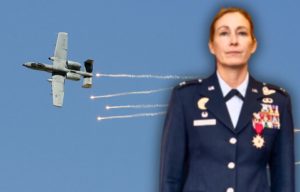
Kim Campbell’s A-10 Warthog is struck by an enemy missile

On April 7, 2003, U.S. Air Force pilot Kim Campbell launched toward Baghdad to strike an Iraqi command post, flying with her flight lead, Lt. Col. Rick “Bino” Turner. As they neared the target, their mission abruptly changed when a desperate call for help came through: soldiers from the 3rd Infantry Division were pinned down and urgently needed close air support.
Over the sprawling city, Campbell and Turner faced a volatile mix of dangers. They had to deliver pinpoint strikes while minimizing civilian casualties, all under the constant threat of surface-to-air missiles and with visibility degraded by heavy cloud cover. Despite the pressure, both pilots pressed on, maintaining focus and precision in the chaos below.
Campbell made multiple attack runs, suppressing enemy positions with rockets and devastating 30mm cannon fire. Just as the engagement appeared to be ending, catastrophe struck. A missile slammed into her A-10 Warthog and erupted in an ominous orange fireball that ripped through the aircraft and destroyed its hydraulic systems. The jet lurched into a steep, uncontrolled dive, thrusting Campbell into a sudden fight for survival—one that would push her training, nerve, and resolve to their absolute limits.
Kim Campbell was trained in how to manually fly the A-10 Warthog

A quick lesson while under fire

Campbell had to relearn how to manually fly while under anti-aircraft fire. Fortunately, her piloting skills were sharp enough that it wasn’t overly challenging for her.“Once I flipped the switch to manual reversion, I don’t remember it being overly difficult,” she said. “I was just so relieved the airplane was finally climbing and responding.”
After the critical hit, Campbell and Turner managed to exit the combat zone largely unharmed, and she manually flew the A-10 for 300 miles back to Kuwait.
Landing manually is a completely different ball game

Kim Campbell, however, faced anything but ideal conditions. Her aircraft had sustained extensive damage, peppered with bullet holes and a severely compromised right horizontal stabilizer. After carefully weighing the risks with Turner, they decided to attempt a manual landing. Reflecting on the event, Campbell shared, “[Turner’s] actions after I was hit were absolutely critical. I was so focused on flying the airplane, getting it under control, whereas he had more awareness of what was going on around me.”
Campbell successfully landed the A-10 and was awarded the Distinguished Flying Cross for her heroism. Lt. Col. Mike Millen, Chief of the 355th Fighter Wing Commander’s Action Group, praised her skill, saying, “Kim landed that jet with no hydraulics better than I land the A-10 every day with all systems operational.”
Interestingly, when Campbell later practiced similar manual landings in simulators, the outcomes were not as successful.
Kim Campbell went right back to it

Even though she showed bravery in the moment, Kim Campbell confessed that she was truly frightened inside. “When I go back and listen to the audio recording [of the flight], I can hear the fear, I just didn’t have time to think about it,” she recalled. Nevertheless, she climbed back into the cockpit the next day.
More from us: The Remarkable North American P-82 Twin Mustang Was Two Aircraft In One
Now retired, Campbell logged 1,800 hours of flight time and completed over 100 combat missions in the A-10. For her, it’s all about being an excellent pilot. “I never wanted to be labeled as a female fighter pilot,” she explained. “I wanted to be the best pilot. So just work hard and be credible. Be good at what you do.”