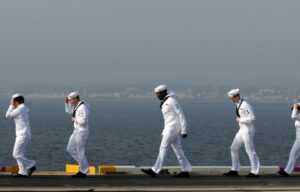
For centuries, life aboard ships forged a distinctive language among sailors—born from battling storms, tending to shipboard duties, visiting far-off ports, and sharing the tight-knit bonds of life at sea. Over time, many of these nautical terms drifted ashore, quietly becoming part of everyday English without most people realizing their maritime beginnings.
Curious about the seafaring origins of words and phrases you use every day? Embark on this linguistic voyage—you might be surprised at how much of modern speech was shaped on wind-swept decks and among the creaking rigging of centuries past.
Knot

Let the cat out of the bag

The phrase “letting the cat out of the bag” originated in naval slang and referred to the act of flogging. Here, the “cat” represents the cat o’ nine tails—a powerful whip with multiple tails kept inside a cloth bag. Sailors knew punishment was imminent when an officer removed the whip from its bag.
Ship’s husband

When a ship is heading back to port for repairs, sailors often casually refer to it as returning to its “husband.” Here, “husband” denotes the person overseeing the shipyard responsible for restoring the vessel to seaworthy condition.
Carry on

Most are familiar with the British phrase, “Keep calm and carry on,” but were you aware that the last part has naval origins? On days that experienced particularly good weather – gentle winds, if we’re being specific – the order to “carry on” would be given.
This indicated that all available sails should be raised.
In through the hawsepipe

“In through the hawsepipe” is Navy slang used by seamen who become officers through non-traditional means, describing their rise through the ship’s ranks. In this context, it signifies starting from the very bottom. The hawsepipe, also known as the hawsehole, is the hole in the bow through which the anchor cable passes.
Scuttlebutt

“Scuttlebutt” in naval slang refers to a rumor. Its origins trace back to “scuttle,” meaning the deliberate sinking of a ship by creating openings in its hull, and “butt,” the common water receptacle where sailors would gather for conversation. Essentially, it represents the impact rumors can have on morale.
Taken aback

While it might not seem like a phrase of naval origin, the fact is that “taken aback” is a form of Navy slang! Modern speakers use it to describe when they’re shocked or surprised about something, but it originally referred to when a sudden strong gust of wind hit a ship’s sails and pushed them in the opposite direction.
He knows the ropes

This term, commonly used in the English language, was originally used to describe a novice sailor. It would be printed on their discharge and meant they knew the names and purpose of a ship’s main ropes… Basically, it informed their superiors that they knew the very basics of seamanship.
Spinning a yarn

Today, to spin a yarn means to tell a story, one that’s perhaps slightly exaggerated. Its seagoing origins date back to naval officers who believed that, if seamen spent too much time telling stories, then no work would be done.
At least once a week, a ship’s crew would have to unravel old lines of rope. During this, the men could converse and tell stories as much as they pleased, and the time became known as “spinning yarns.” Eventually, telling a tall tale turned into spinning a yarn.
Devil to pay

This expression is used today to describe that something unwanted is looming. However, some claim the term originates from the despised task of waterproofing a wooden ship’s longest seam along the keel. This is sometimes disputed, but there are many who believe it.
The seam was named the “devil” and would be “paid” or covered by tar. Paying the devil was an extremely unpleasant and difficult job, and the name was eventually used to describe any unwanted situation.
On the fiddle

The fiddle was a raised lip around the edge of a sailor’s plate. If food touched it, this meant he had too much and was described as being “on the fiddle.” This could earn him a whipping.
Bokoo

A sailor may say the word bokoo, meaning “many.” This actually comes from the French word, beaucoup, which has the same meaning. The spelling was simplified over time and is an example of the many words from other languages that have been incorporated into Navy slang when traveling the world.
Square meal

Peacoat

A peacoat is a thick jacket worn by sailors during bad weather. A potential origin for the name comes from the material from which it’s made: pilot cloth. Sailors would refer to the coarse, heavy fabric with the initial “P,” instead of pilot, which eventually became the “pea” in peacoat.