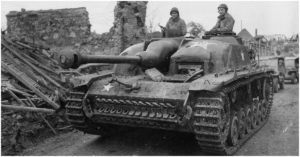
In this Dakota Hunter Blog, you will read about an insane plan that the Germans deployed in a final effort to break the imminent Allied invasion of their homeland. This Ardennes Offensive aka “The Battle of the Bulge” took place just 5 months before the Third Reich would completely collapse in April 1945. While all military fronts around Germany’s borders from the West and South were about to be squeezed to inside the German “Heimat”, a most daring (or rather a desperate) counter attack with SS panzer divisions and Infantry was launched from the Ardennes in Luxembourg and Eastern Belgium.
Their major mission was to slice through the Allied forces with the element of surprise and the poor winter weather, hopefully keeping the Allied Airforces on the ground for a couple of days. In such optimistic scenario, they imagined that the German Army should be able to sweep via Brussels to the harbor of Antwerp, in order to keep that seaport out of Allied hands. And consequently cut off the supplies to the combined American, Canadian, and British troops that had reached in late summer of 1944 the provinces of Zeeland, Brabant, and Limburg in the south of the Netherlands.
With no more air superiority, this German “Blitz” attack seemed very unrealistic to ever be accomplished according to plan. Even for some high ranking German Officers, the plan had the “desperado” features of a near Kamikaze assault, akin to the array of mad military operations that had earlier escaped from Hitler’s twisted mind. Imagine, the planned German penetration into the enemy-occupied territory from Bastogne to Antwerp had a distance of more than 200 km/ 120 miles! The outcome of this “Battle of the Bulge” must have been very harsh for the German troops involved and for the megalomaniacal Fuhrer. Allegedly, he suffered from a rapidly deteriorating mental health with depressions and attacks of extreme rage.
His pride, the German panzer troops were well-trained and fanatic soldiers with superior tanks but their backup plan was lousy or rather non-existing. Consequently, they ended at only 25 % of the projected distance, at some 50 km west of Bastogne. There it was that their once much-feared War Machine creaked to a halt. Even before they could reach Dinant, their tanks ground with empty fuel tanks. And not only lack of fuel, also ammo, food and no chance at all for any aerial supply droppings for the relief of their miserable situation. Worse, a whole lot of shaking inflicted by the British, Americans and French Armies would soon come over them and they let them suffer to the max. The Battle of the Bulge was over in a matter of 3-4 weeks but left a large number of casualties that virtually were in vain as the downfall of the Third Reich was irretrievable.

My Blog will focus mainly on what happened around this Chateau Rolle (or Rolley in French), just a few miles Northwest of Bastogne, well-situated on a hilltop and surrounded by dense forests and lakes. It was selected as the top location to serve as the US Army Command Post and became during the legendary “Bastogne Siege” (20-27 December 1944) the priority target of a German assault with seven tanks and infantry.
The defense of the Chateau Rolle was assigned to a legendary Regiment: the 101st Airborne Division or Screaming Eagles, one of the most decorated formations of the U.S. Army. Below you’ll see the logo/ patch of that Division plus at right, the one of the 502nd Parachute Infantry Regiment (502nd PIR), which was assigned as a regiment of the 101st Airborne Division, That 502nd PIR had also performed so outstandingly in Normandy, in early June 1944. At the start of the D-Day invasion, their mission was to destroy a German battery of 122 mm howitzers near Ste Martin-de-Varreville, close to Utah Beach. I visited that site many times during my 10+ years pilgrimage trips to Normandy and was impressed by the audacity of that assault against a gun battery on a steep hill.

I revisited this privately owned Chateau Rolle following an invitation from the family of my son-in-law. His family owns this historical site with the beautiful “Chateau et Domaines” since 1878. The Castle and its vast acres of land are not open to the public, so see the rare photos of this awesome place. It was also in this Castle that I found a remarkable book, named “The battered Bastards of Bastogne”, published by Publisher Casemate USA in 2003. They are also the Publishers of my book The Dakota Hunter (2015) and gave me the permission to copy a number of photos, captions, and excerpts from that Bastogne book that I found. That is much appreciated, as the author, George Koskimaki, gives in this book a perfect “Chronicle of the defense of Bastogne, December 19, 1944- January 17, 1945“.

The Chateau Rolle was earlier selected by the 101st Airborne Division as their Command Post, due to its remote, hidden position yet very close to Bastogne. The complex with its many houses and stables served not only as a Command post with all Radio Communications but also as barracks for the soldiers (101st Airborne /502nd PIR), as an infirmary for the wounded, as a kitchen and weapons depot. Once the siege was broken, General Patton came over to honor the US troops that had achieved the unthinkable, by stopping the German Tank attacks and rejecting to surrender as was being asked by the German Generals.
Instead, the legendary message “Nuts” was given as a reply by General Mcauliffe (see photo above). His troops were able to sit out the battering and knock out the tanks that came in. Relief came their way with aerial droppings and finally, Patton’s Army was able to set them free. With the massive annihilation of the German Tanks and Infantry, the “Battle of the Bulge”ended as a disaster for the German Panzer Army.
Here follows an excerpt from the book: It is written by Captain Joseph Pangerl in a letter to his parents December 30, 1944: “Just now, I am in a beautiful 17th-century castle which also serves as my home. It has been modernized but, naturally, still has the three-foot thick walls all around and you know what that means in combat, dad. In front of the castle is the former castle: this one of the 10th century. The first days here I spent quite a lot of time going around taking pictures. The setting here is much like a Hollywood one. We are on a small hill with hills all around us, covered with pine forests. There are the small lakes and rushing brooks that you always associate with such a setting and the fact that it snowed over a week ago and all the snow is still on the ground makes everything look like a Xmas postcard”.
He also describes the surprise visit that General Patton made to the Chateau. See the photo on top. Two Top Brass Soldiers were at the Chateau, the 502nd Parachute Infantry Regiment HQ when the General arrived to award its commander a DSC and to inspect enemy tanks which had been knocked out near the chateau. Capt. Joseph Pangerl: “ This afternoon we had the pleasure of General Patton’s presence. He came right out of the castle and pinned a medal on our Colonel, for we were the regiment that finally stopped the last big German effort. I was waiting for him with my camera outside and as I took his picture he walked over toe me and said, “Now get a good one”.

The peaceful view of this picture could change in a matter of seconds , as was described by Lt. Henry Barnes in his harrowing report from the Chateau: “The noise of firing, explosions, and shriek of incoming shells increased with daylight. A medical officer ran over to me and told me to get ready to burn all our medical books of tags so the enemy couldn’t know how many men we had lost. Everyone was running around: suddenly the courtyard was cleared and most of the able-bodied personnel followed a captain down the road and took up defensive positions along another road. Here it was Christmas morning in a Belgian Chateau with a room full of wounded and outside all hell was breaking loose. I glanced at the wounded and smiled comfortably and went outside behind the chateau and relieved myself…..The shooting was just outside the wall and the sound of grinding tanks could be heard. We heard there were seven tanks outside with about a company of infantry…..A shout caused me to run back into the aid station and on our walkie-talkie, a shrieking voice shouted in German, filled the room with discordant sound. Our medical officer listened in disbelief and said that it must be one of the tank commanders outside giving orders. It shut off and left us bewildered. Back to the wounded I went and told them what was going on and said I would stay with them when someone ran in shouting “We’re getting them!”. I whooped with delight and ran down the slope. Four German tanks were in flames”.

The siege of Bastogne lasted for a week from 20-27 December 1944. Patton’s 3rd Army broke the “Ring of Fire” on 27 December from the South. The map is reflecting the situation on 30 December 1944. The Chateau Rolley is only 1 km east of the little village Champs, seen on the map northwest of Bastogne, very close to the frontline of the American held “pocket” and was already attacked by the SS Panzer Tanks on Christmas Day 1944, one week earlier.

With the help of my friend Bart Nopper and Roland Korst, we found the aircraft, including that patched bullet hole and a whole lot of Wartime documentation! With the local wrench jock Kenny, we cut off the cockpit, transported it to Holland for a Star Display in the Museum “Wings of Liberation” in Brabant, The Netherlands, near Eindhoven. Read my next week’s Dakota Hunter Blog “Lucky Bastogne Veteran C-47 found back” for the full story and photos.


But the resistance that came from the Americans was so defiant and gallant with a handful of men, light weapons, and only 3 Bazookas, that they were able to knock out the attacking German tanks and infantry that had arrived on the threshold of the Chateau. Probably, the German Tank Commander must have thought that with their firepower and Panzer, it was “easy meat’” to conquer the Chateau, maybe even with a capitulation on first sight of the approaching tanks. But, hélas for them, there was no capitulation. Instead, the US Soldiers dug in and countered with very accurate fire from guns, mortars, and bazookas. In no time the German tanks were disabled with broken tracks and their infantrymen were shot and killed before the tank guns could inflict any serious damage to the Castle.
Read this report from the book: “They yelled “Germans are coming”- we’ve got to go out and dig foxholes and get ready to fight a war!” I went out there and it was like digging in cement. I got next to a hedge. Four Mark IV Tanks came and a couple of TD’s knocked out some of them and the rest were disabled by Bazookas”. As a member of the demolition Platoon of the 502nd Regiment, Sgt. “Sky” Jackson won his second Silver Star on Christmas Day in front of the regimental HQ when he disabled an enemy tank, part of the attacking force which was threatening to overrun that command post (the Chateau)…… “We had mined a bridge leading to the Chateau, but it was so cold that everything froze and we couldn’t blow it up. I ran out of the door and saw five tanks coming through the snow with the German infantrymen riding on them. I ran and got a Bazooka as the rest of our guys ran out and reinforcements started coming in from the town. I hit the first one in the track and knocked it out. Then we got the others and killed all the infantrymen”.


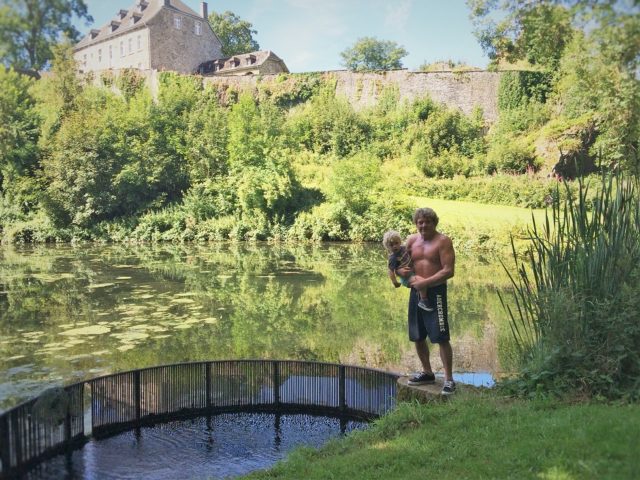
I have written a book The Dakota Hunter, in which I describe my adventures and my lifetime passion with War History and its Transports as the Jeep, the Harley Davidson motorcycle and vintage aircraft as the Douglas C-47/ Dakota and the PBY-5A Catalina. As a young kid I grew up in the post-war Borneo Jungle and was from Day One confronted with all those Goodies, in an environment that was littered with wrecks but also with operational transports left over from the Pacific War. Bunkers, stranded submarine & Landing Craft, crashed airplanes, unexploded bombs, Japanese stragglers that popped from the Jungle, but also Jeeps and GMC Trucks all over the place in which my Dad drove around with his “wrecking crew” to get the oil-drilling rigs and derricks back to work again. His employer Shell came back in business right after the war and bought a couple of surplus PBY-5A Catalinas to fly us around the archipelago. Along with our frequent Douglas DC-3/ C-47 flights to Java, I can tell you that I had seven most fascinating years that left a “footprint” in my soul which never faded away.
Playstation was not invented yet, but I had mine in the 1950’s, as I walked out from our house into the Jungle. As an always curious, exploring and adventurous kid, I had the time of my life on that Pacific Island (and never really lost that curious and exploring nature). A passion was born and that played up later in my life. I quit my job and went in search of the legendary DC-3/ C-47 on the last Frontiers of this World. Crashed , abandoned, on a boneyard, or still flying, I found them in all states of (dis)repair. But I also found the confrontation with the Military, or worse, the local Militia or Drugs Lords who use the DC-3/ C-47 for the transport of their “soldiers” and illicit trade. You can read it all in my book (see jacket design of the Dakota Hunter below).
Selected from my lifetime adventures and encounters with vintage aircraft, I have collected the best stories in my book of 320 pages, engagingly written and illustrated with 250 unique photos. Meet the pilots, the remote communities, and the planes. 20 years of expeditions, in search of the legendary DC-3/C-47. I found them in the High Andes, The Yukon, Alaska, Honduras, Madagascar and the Jungles of the Amazon, where the Dakota still reigns as the only transport to bring you in and out of the dense forests of the Green Hell. The very last Frontiers of this world are out there, in Colombia.

For ordering this book, you can go directly to the Amazon page by clicking here at Ordering at Amazon The Dakota Hunter Book, in print version or as E-book. For 5-star reviews of my book, scroll down on that Amazon page. More Previews and an array of my earlier Dakota Hunter Blogs are to be found at www.dc3dakotahunter.com. Also, you can order one or both books (in print- version or as e-book) via my publisher’s website. Click here for Casemate’s site.