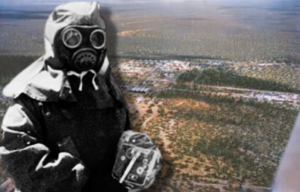
After World War II, United Kingdom made the development of nuclear weapons a cornerstone of its national defense strategy. To advance its atomic program, the UK turned to Australia, utilizing the vast, remote expanses of the Outback as testing grounds. Although the Australian government consented to the arrangement, the environmental damage and long-term effects on nearby communities remain evident more than seventy years later.
British nuclear tests in the Australian Outback
During the 1950s and 1960s, Britain conducted 12 nuclear tests in Australia, along with hundreds of smaller experiments. Seven tests took place in Maralinga, a remote area in South Australia’s Great Victoria Desert, to evaluate the performance and safety of nuclear technology being developed.
The main test series were called Operation Buffalo and Operation Antler. While these were the largest tests, the smaller experiments reportedly caused more widespread nuclear contamination. Some of these smaller tests created mushroom clouds that rose 47,000 feet into the air, with radioactive fallout reaching as far as Townsville.

The most intense testing happened in 1960, 1961, and 1963 during the Vixen B trials at the Taranaki site. These experiments focused on studying how nuclear weapons reacted to fire and released over 40 kilograms of uranium and 22.2 kilograms of plutonium.
To put this in perspective, the atomic bombs dropped on Japan in World War II – Little Boy and Fat Man – contained 64 kilograms of uranium and 6.4 kilograms of plutonium, respectively.
Cleaning up the Australian Outback after the nuclear tests
Britain ended its nuclear testing in the Australian Outback in 1963 after both countries signed the United Nations Partial Ban Treaty. Cleanup efforts began in 1967, with contaminated materials buried in trenches and sealed with concrete. In 1968, British physicist Noah Pearce released a report that led Australia to release Britain from further responsibility at the Maralinga site—but it was later found that the report’s findings were inaccurate.
The full extent of the nuclear tests wasn’t made public until 1984, when growing public pressure forced the release of key information. A Royal Commission report from 1984–85 revealed that the site still posed “significant radiation hazards” and criticized Australia’s safety measures, especially the harm done to local Indigenous communities.

Although the Tjarutja people were granted native title to the land in 1985, a full cleanup didn’t begin until a decade later. The Australian government carried out the cleanup over five years, spending more than $170 million. In 1993, Britain agreed to pay €20 million as a goodwill gesture.
By 2000, most of the roughly 3,200-square-kilometer area was declared safe for unrestricted access—except for about 120 square kilometers that remained off-limits.
Radiation concerns still remain
The Maralinga Rehabilitation Technical Advisory Panel (MARTAC) reported in the early 2000s that the plutonium contamination at the Taranaki site had been incorrect by a factor of 10. They wrote, “A comparison between the levels reported by the U.K. at the time and the field results reported by the Australian Radiation Laboratory […] demonstrates an underestimate of the plutonium contamination about an order of magnitude.”
Recent research conducted by Melbourne’s Monash University found that “hot particles” still exist in the soil. These are microscopic remnants of uranium and plutonium, which, due to the harsh environment of the Australian Outback, are slowly releasing plutonium into the soil and groundwater.

The chemicals present are between a few micrometers and nanometers in size. Some have created “a plutonium-uranium-carbon compound that would be destroyed quickly in the presence of air, but which has held stable by [an iron-aluminum] alloy.” These chemicals are likely the result of the cooling of molten metal droplets from the initial nuclear explosions.
Researchers found the plutonium has resulted in the continued release of radiation into the environment, where it’s absorbed and ingested by humans, animals and plant life. While more research is needed regarding the breakdown of these particles and the impact of weather on their release, the study overall is a guide for environmental protection.
The contamination has caused long-term health effects

Since regaining stewardship of their ancestral lands, Indigenous communities near sites such as Maralinga have faced profound social, emotional, and physical challenges. In some areas, crops remain unsafe for consumption, and sections of the soil are still too contaminated to support healthy vegetation.
With cautious optimism placed in ongoing scientific research, these communities continue to seek solutions that can restore the land while also addressing the long-term health effects endured by their people.
More from us: The Nuclear War Between Russia and China That Almost Happened