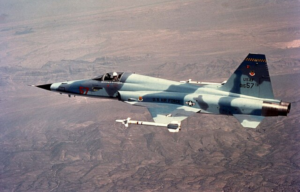
Developing a lighter, faster and smaller supersonic fighter

The origins of the Northrop F-5 trace all the way back to the 1950s, when Edgar Schmued—Northrop Corporation’s vice president of engineering and a veteran aircraft designer—challenged his team to defy convention. While rival companies focused on producing large, complex jets, Schmued wanted something different: a sleek, agile fighter that was dependable, cost-effective, and easy to maintain.
More interested in a trainer than a combat aircraft

Northrop’s F-5 traces its origins to the N-156F project, a design initially created in hopes of securing a contract with the U.S. Air Force. At the time, however, the service was more interested in the development of a supersonic trainer rather than a lightweight fighter, a requirement that ultimately produced the two-seat YT-38 Talon, which went on to become a cornerstone of American pilot training.
Northrop F-5A/B Freedom Fighter vs. F-5E/F Tiger II

The first iterations of the Northrop F-5 were the “A” and “B” Freedom Fighter models. As aforementioned, they entered service in the 1960s, during the height of the Cold War, with more than 800 being manufactured and delivered to international partners.
Following the International Fighter Aircraft Competition, the Northrop Corporation introduced a more advanced version of the F-5. The “E” and “F” variants – the Tiger II – featured several upgrades, including a better fuel capacity, advanced avionics, a greater wing area with improved leading edge extensions, an inertial navigation system and the air-to-air refueling capabilities.
Similarly to the previous versions of the fighter, the F-5E/F was (and continues to be) operated by American allies. While some units are flown by branches of the US military, this is in more of a training capacity. By the time production ceased in 1987, the total number of aircraft produced under these two variants was around 1,400.
Northrop F-5E/F Tiger II specs.

As aforementioned, the Northrop F-5E/F Tiger II is the more advanced version of this lightweight fighter – but how is it different from its “A” and “B” predecessors? Well, for starters, it features a much more powerful pair of engines, replacing the original J85 power plants with more capable J-85-GE-21s. These allow the F-5E/F to reach a maximum speed of Mach 1.63, with a 140-mile range when carrying weaponry on its hard points.
Speaking of weaponry, the F-5E/F makes use of a combination of aircraft-mounted cannons and droppable munitions that allow it to hit targets both in the air and on the ground. It’s primary armaments are two 20 mm M39A2 Revolvers at the nose, while its seven hard points (one under the fuselage, four at the wing-tips and four under the wings) allow for the equipping of a variety of missiles and rocket pods and/or the storing of drop fuel tanks and air-to-ground ordnance.
Operational service over the decades

Despite being designed in the 1950s, the Northrop F-5 continues to see active service around the world, with the likes of Brazil, Mexico, Thailand, Honduras, Iran and others still equipping it.
In regards to the US Air Force, the fighter first entered service as a trainer with the 4441st Combat Crew Training Squadron at the former Williams Air Force Base, Arizona. The following year, the F-5 underwent a combat exercise in Vietnam with the 4503rd Tactical Fighter Squadron and South Vietnamese forces. Dubbed Skoshi Tiger, it saw 12 modified aircraft, redesignated the F-5C, fly more than 2,500 combat sorties in the skies over Vietnam.
More from us: Did You Know the MiG-28 Fighters in ‘Top Gun’ Don’t Actually Exist?
Nine of the fighters were lost during the five-to-six-month period the test ran. While overall deemed a success, the Air Force still failed to show enough interest to utilize the F-5 outside of its training capacity.