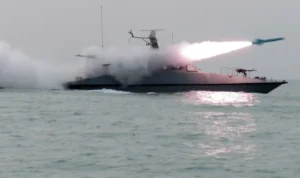
Iran’s February 2026 Hormuz drills revived an old lesson: one mine can flip a standoff into the biggest U.S. surface action since WWII.

In February 2026, Iran briefly closed parts of the Strait of Hormuz for live-fire drills while nuclear talks with the U.S. moved forward again in Geneva—the kind of headline that makes shipping markets twitch and admirals start double-checking maps.

If that sounds familiar, it should. In the 1980s, the Gulf’s “Tanker War” turned the waterway into a pressure cooker—mines, small-boat attacks, and convoys threading through tight sea lanes. Then one explosion changed everything.
The Mine That Lit the Fuse

On April 14, 1988, the U.S. guided-missile frigate USS Samuel B. Roberts (FFG-58) struck an Iranian mine in the Persian Gulf. The blast nearly forced an abandon-ship, but the crew’s damage control saved her. The U.S. Naval Institute recounts how violent the shock was—and how close the ship came to being lost.
That mine mattered because it transformed a tense “gray-zone” contest into a question Washington couldn’t ignore: how do you punish the act without accidentally starting a regional war?
April 18, 1988: “Proportional Response,” Maximum Consequences
Four days later, on April 18, the U.S. launched Operation Praying Mantis—a combined sea-air strike meant to hit Iranian assets tied to attacks on Gulf shipping. U.S. warships and aircraft targeted Iranian oil platforms being used as military outposts and command-and-control nodes.
The action escalated quickly as below:
- At the Sirri platform, U.S. ships opened fire after warnings; the platform caught fire, and the planned boarding became unnecessary.
- Then, Iranian forces came out to fight. A key clash involved the Iranian missile boat Joshan, which fired a Harpoon; U.S. ships answered with Standard missiles and gunfire until Joshan was sunk.
- Later, U.S. aircraft and surface combatants attacked the frigate Sahand, leaving it burning and ultimately sunk. Another frigate, Sabalan, was hit and left badly damaged.

By sundown, multiple Iranian naval units were sunk or disabled, and two Iranian platforms were blazing. In a widely cited summary, the National Veterans Memorial and Museum calls Praying Mantis the largest naval battle since World War II, noting the mine damage to Roberts and the one-day scale of the retaliation.
USS Simpson, which sank Joshan, was the last modern US naval ship to sink an enemy vessel and was decommissioned in 2015.
How hard did Iran get hit? The safest factual framing is: major surface combatants were knocked out, and U.S. Navy histories describe the day as “swift and deadly.” Some modern retrospectives go further, arguing the U.S. effectively wiped out “nearly half” of Iran’s operational fleet in the action.
Why It’s Back in 2026 Conversations
When Hormuz flares up—drills, threats, deployments—Praying Mantis resurfaces because it’s the textbook example of the Gulf’s brutal math: cheap mines can trigger expensive, high-speed escalation. The same narrow geography that makes the strait economically vital also makes it militarily unforgiving—then and now.