In recent years, headlines about tech billionaires quietly building underground bunkers have become almost routine. From New Zealand bolt-holes to luxury shelters hidden beneath American ranches, the ultra-wealthy are preparing for worst-case scenarios—pandemics, cyberwarfare, and even nuclear conflict.

But this instinct to go underground during uncertain times is far from new. Britain faced the same fear—on a national scale—during World War II, when enemy bombers turned cities into targets and civilians into frontline survivors. The result was one of the most ambitious civil defense efforts in history: a vast network of air raid shelters designed to protect ordinary people from modern warfare.
The Anderson Shelter: Britain’s First Mass-Produced Bunker

The most iconic British air raid shelter was the Anderson shelter, introduced in 1939. Made from corrugated steel sheets bolted together and buried partially underground, it was designed to be assembled quickly in gardens and allotments.
Around 3.6 million Anderson shelters were produced, many for free to low-income households. They were simple, damp, and uncomfortable—but they saved lives. The earth piled on top absorbed blast waves and shrapnel, making the Anderson shelter surprisingly effective during the Blitz. Families often slept inside for months at a time, enduring cold, flooding, and fear together.
The Morrison Shelter: A Bunker Inside the Living Room

Not everyone had a garden, especially in Britain’s dense cities. The answer was the Morrison shelter, introduced in 1941. Unlike the Anderson, this shelter sat inside the house, resembling a heavy steel table reinforced with wire mesh.
During air raids, families crawled underneath and waited. When houses collapsed, the Morrison often held up falling debris, creating survivable pockets. It wasn’t glamorous—but it reflected a critical wartime lesson: protection had to adapt to real living conditions, not ideal ones.
London Went Underground: Public Bunkers Beneath the City

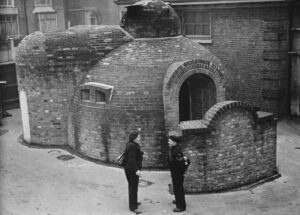
Britain also relied heavily on communal shelters, including repurposed basements, reinforced street shelters, and famously, London’s Underground stations. Night after night, thousands descended into tunnels, platforms, and passageways to escape the bombing above.
These shelters became strange underground communities, complete with bunks, tea stalls, music, and rules. They weren’t always safe—some stations suffered direct hits—but for many civilians, they were the only option.
From Corrugated Steel to Luxury Survival

Today’s billionaire bunkers are a different world entirely. Climate-controlled rooms, biometric locks, independent power grids, and long-term food systems have replaced steel sheets and sandbags. Yet the logic remains strikingly similar: when technology makes warfare more destructive, survival moves underground.
What changed is scale. In WWII Britain, shelters were a collective solution—mass-produced, government-funded, and shared. Today’s bunkers are private, exclusive, and designed for individuals rather than communities.
The Lesson Beneath the Surface
Britain’s wartime shelters weren’t about comfort. They were about resilience, improvisation, and protecting society as a whole. As modern elites build personal fortresses against global instability, World War II offers a sobering reminder: survival works best when it’s shared—and when preparation isn’t left to the last siren.
History has already tested the bunker idea. Britain didn’t hide underground because it wanted to. It did so because the sky had become a battlefield.