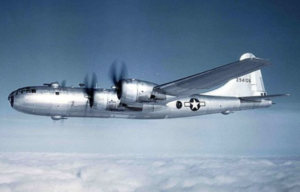
As the United States prepared for the atomic bomb missions over Hiroshima and Nagasaki, Paul Tibbets found himself confronting a significant challenge: many male pilots were reluctant to fly the Boeing B-29 Superfortress. The aircraft was still new, only partially proven, and notorious for its demanding and complicated controls. To counter this hesitation, Tibbets adopted an unconventional solution—he enlisted two female pilots to showcase the bomber’s performance.
The pair handled the B-29 with remarkable precision and composure, expertly managing its complex systems. Their demonstration sent an unmistakable message: if they could fly the aircraft with confidence, any properly trained pilot could do the same. Their bold flight erased remaining doubts, strengthened crew morale, and played a vital role in gaining broader acceptance of the Superfortress—a key step in preparing for one of the most consequential operations in history.
Problems with the B-29 Superfortress’ engines

After completing combat missions in both the European and Pacific theaters, Paul Tibbets returned to the United States in 1943 to contribute to the B-29 Superfortress program. Once testing concluded, he was appointed director of operations for the 17th Bombardment Operational Training Wing (Very Heavy), taking on the critical responsibility of training pilots to master this advanced bomber.
The task was far from straightforward. Many aviators hesitated to fly the B-29, citing concerns over its unreliable engines, frequent onboard fires, and massive size. Pilots accustomed to smaller, familiar aircraft faced a steep learning curve. With the Superfortress still under development and lacking the operational history of earlier bombers, widespread skepticism and apprehension were inevitable.
The women who flew the B-29 Superfortress

To address the growing unease about flying the B-29, Paul Tibbets made the bold decision to train female pilots on the aircraft in hopes of calming the nerves of their male counterparts. He recruited two Women Airforce Service Pilots (WASPs), Dora Dougherty Strother and Dorothea Johnson “Didi” Moorman, and intentionally didn’t inform them of the B-29’s troubled history to prevent any unnecessary worry.
Both Strother and Moorman adapted quickly, experiencing no issues during their training.
In fact, Tibbets specifically chose them because they had no prior experience flying four-engine aircraft. This was done to show that even pilots unfamiliar with such large bombers could successfully learn to handle the B-29. After just three days of training, Tibbets declared them ready for demonstration flights. The two pilots conducted several flights from the base in Alamogordo, New Mexico, with different aircrews aboard each time—effectively boosting morale and proving the aircraft could be flown with confidence and control.
Reception as demonstration pilots

Strother and Moorman successfully convinced the male aviators to fly the B-29. In a maintenance bulletin, Maj. Harry Shilling praised the pair’s expertise and in-depth knowledge of the aircraft, encouraging other male personnel to consult them for guidance on operating the bombers and to emulate their flawless takeoffs.
Despite their achievements, Strother and Moorman’s time as demonstration pilots was short-lived. When Tibbets’ superiors discovered women were flying B-29s, they ordered the program to be shut down.
Maj. General Barney Giles of the Air Staff remarked that the women were “putting the big football players to shame.”
Remembering their role

While their role as demonstration pilots may have seemed minor, it had a profound impact on the men who watched them. On August 2, 1995, retired US Air Force Lieutenant Colonel Harry McKeown wrote a letter to Strother about her experience flying the B-29s. Their paths had crossed in 1944 at Clovis Army Airfield, where McKeown served as Director of Maintenance & Supply and worked as a test pilot.
He recalled that after their demonstration, “we never had a pilot who didn’t want to fly the B-29.” He ended his letter on a personal note, writing, “I still want to thank you for helping me that day at Clovis. I will admit that I was scared… You made the difference in my flying from then on. I wasn’t the only pilot that felt this way, and I am sure that they would thank you too if they knew where you were.”
Life after World War II

Both women continued serving with the Women Airforce Service Pilots (WASPs) until the organization was disbanded in 1944. Dora Dougherty Strother later earned a PhD from New York University and built a long professional career at Bell Helicopters, working there from 1962 to 1986. She remained close friends with fellow pilot Joe McKeown, and eventually married him in 2002. Dorothea Moorman made her home in North Carolina, raising five children. She stayed in touch with Paul Tibbets until her passing in 2005.
Despite their wartime contributions, official recognition for Strother, Moorman, and the rest of the WASPs did not come until 1977—over thirty years later. That year, Congress enacted legislation granting them military veteran status, finally acknowledging their service and providing the honors and benefits that had long been withheld.