Maynard Harrison Smith’s early life

Maynard Harrison Smith was born on May 19, 1911, in Caro, Michigan. His father was a lawyer, and his mother worked as a teacher. Although his childhood was fairly stable, Smith had a reputation as an outsider and had trouble fitting in. Hoping to instill discipline, his parents sent him to Howe Military Academy in Indiana.
As an adult, Smith worked as a tax field agent for the U.S. Treasury, but much of his financial support came from an inheritance. His personal life was unsettled. He married for the first time in 1929, but the marriage ended after three years. A second marriage in 1941 lasted only one year, producing a child and leading Smith into legal problems caused by his own actions.
Two options: Go to jail or join the US Army

Following his second divorce, Maynard Harrison Smith was arrested for failing to pay child support. He appeared before a judge and was given a choice: going to jail or joining the US Army. To avoid jail, Smith chose military service.
At 31, Smith began basic training as one of the oldest recruits, harboring resentment toward younger officers whom he felt lacked experience. Believing that the US Army Air Forces (USAAF) offered the quickest path to advance his career, he volunteered for Aerial Gunnery School.
Smith’s small size made him well-suited for the confined space of a ball turret. After completing his training, he earned the rank of staff sergeant and was assigned to the 423rd Bombardment Squadron, 306th Bombardment Group, Eighth Air Force, where he served on a Boeing B-17 Flying Fortress.
Attacking the U-boat pens at Saint-Nazaire

Maynard Harrison Smith’s fellow airmen didn’t like him much and he was soon given the nickname, “Snuffy Smith.” He flew his first combat mission on May 1, 1943, which would be the first time the irascible, disagreeable aerial gunner would show his true colors.
The target of the mission was the German U-boat pens at Saint-Nazaire, on France’s west coast. The location had been nicknamed “Flak City” by Allied airmen because of the heavy German anti-aircraft defenses that had been erected there.
The first part of the mission suffered issues, as many of the American bombers tasked with attacking the site suffered mechanical problems, but the middle portion went off without a hitch. After the B-17s had dropped most of their bombs, however, they were engaged by Luftwaffe fighters.
The American bombers fled into a large cloud bank to evade the Germans, and while this was successful as an evasive maneuver, it resulted in them flying well off course.
Fire aboard the Boeing B-17 Flying Fortress

The navigator was the first to catch sight of land, but he misidentified it as the coastline of Britain. Acting on that assumption, the pilot lowered the B-17 to an altitude of only 2,000 feet. In reality, the aircraft was bearing down on Brest along the French shoreline. As the bomber broke through the cloud cover, it was instantly engulfed by hostile fire—anti-aircraft bursts erupting from below and German fighters diving from the skies.
The assault focused heavily on Smith’s plane. Fragments from flak shells tore into a fuel tank on the wing, spilling gasoline into the fuselage. Within seconds, flames surged to life, intensified by oxygen leaking from the ruptured system.
Smith, locked inside the powerless ball turret, was forced to crank it manually to escape. Pulling himself into the fuselage, he was confronted with devastation: fire consuming the interior, gaping holes ripped through the metal, and vital controls smashed beyond use. Two crewmen lay severely injured, while dread spread among the survivors.
In panic, the radioman hurled himself from the aircraft without a parachute. Soon after, two more men chose the sea’s slim chance over the inferno and bailed out into the open sky.
Maynard Harrison Smith takes control of the situation

Maynard Harrison Smith didn’t know if the pilot was alive or dead, or whether he’d bailed out of the burning B-17 like the other three had just done, but he did know that six crewmen with varying degrees of injuries remained and he wasn’t one to just stand there and let them burn to death.
As long as the B-17 kept flying, Smith decided he would do what he could to extinguish the flames, help out his injured comrades and fight off the Germans, who were still attacking the burning bomber. Wrapping himself in whatever protective clothing he could, he fought the flames first with fire extinguishers. When those were used up, he used bottles of drinking water and any other non-flammable liquids he could get his hands on.
Despite his best efforts, the fire continued to spread, and the flames were getting so intense in some areas that ammunition was starting to go off. Smith realized he had another task to take on single-handedly: toss the burning ammunition boxes overboard before they could explode.
Between throwing burning ammunition into the sea, tending to his wounded comrades and fighting an endless battle against the flames – for which he even used his own urine in desperation – the aerial gunner also manned two machine guns, fighting off the German fighters until they finally gave up and flew away.
At this stage, it was clear the B-17 was a write-off and their only hope was to land before it fell apart. Somehow, the pilot managed to achieve this and landed the almost-destroyed bomber on a British airstrip. A few minutes after landing, the B-17, riddled with 3,500 bullet holes and held together only by the four main beams of its frame, fell apart. The men were all safe, however, thanks to Smith’s heroic actions.
Maynard Harrison Smith was awarded the Medal of Honor

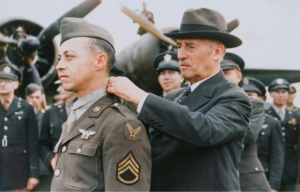
For his immense courage, Maynard Harrison Smith was awarded the Medal of Honor, becoming the first enlisted airman of the US Army Air Forces to receive this distinction.
When the time came to award him with the medal, however, he was nowhere to be found. Eventually, he was located scraping leftovers from breakfast dishes, having been assigned this duty as a disciplinary measure. It was ultimately presented to him by Secretary of War Henry L. Stimson at the Eighth Army Airfield in England.
Following his gallantry in the skies, Smith flew four more combat missions, before being grounded for combat stress reaction. He was subsequently assigned to clerical work, which he was less than adequate at – his poor performance led to him being demoted to the rank of private.
He returned Stateside in February 1945 and was discharged a few months later. On top of his Medal of Honor, he was awarded the USAAF Enlisted Aircrew Badge, the Air Medal with Bronze Oak Leaf Cluster, the American Campaign Medal, the European-African-Middle Eastern Campaign Medal with four Bronze Campaign Stars and the World War II Victory Medal.
Maynard Harrison Smith’s later life

Shortly before the close of the Second World War, Maynard Harrison Smith married his third wife, with whom he had four children – three sons and a daughter.
While he initially ran into legal troubles during his re-entry into civilian life, Smith did manage to make a comfortable living. Following his retirement, he moved to Florida. He passed away from heart failure on May 11, 1984, at the age of 72.
More from us: Was the Allied Bombing of Dresden a War Crime or Wartime Necessity?
Like so many veterans, he was interred at Arlington National Cemetery.