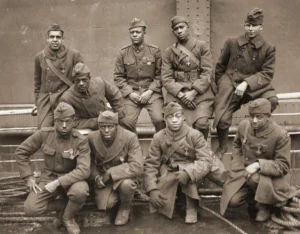
February is Black History Month in the United States, a time to look back at stories that shaped the country, but often left out of discussions. One of those stories unfolded during World War I, when the U.S. military faced a simple reality: it needed soldiers—fast. What followed was a contradiction that still feels familiar. Black Americans were called to serve in massive numbers, sent overseas, and asked to help win a global war, while the nation debated how much trust they deserved.

That tension shaped some of the most compelling U.S. stories from the Western Front and explains why some of the most decorated U.S. soldiers of the war fought under foreign command instead of their own flag.
Why the U.S. Army Needed Black Soldiers in WW I—But Questioned Their Role
When the U.S. entered World War I, more than 350,000 Black Americans served overseas in the American Expeditionary Forces. Many were assigned to labor and support work—building roads, unloading ships, moving supplies—jobs that quietly kept armies alive.
Two segregated combat divisions became the exception: the 92nd Division (under U.S. command) and the 93rd “Provisional” Division (initially under the French), built around four infantry regiments—the 369th, 370th, 371st, and 372nd.
How Black Units Ended Up Fighting Under French Command

Here’s where the story turns: the U.S. Army didn’t just deploy the 93rd. It effectively assigned those regiments to fight under French command, a rare arrangement that spoke volumes about the era’s attitudes and internal politics.
The French, desperately short on troops and less invested in America’s segregation rules, put these regiments into the line. For the men of the 93rd, that meant French helmets, French rations, French tactics—and, in many cases, a clearer path to prove themselves in combat.
The Harlem Hellfighters: Assigned, Tested, Thrown Into the Fight
The most famous of these units was the 369th Infantry Regiment, later nicknamed the Harlem Hellfighters. They were assigned to the French Army in April 1918, and they saw heavy action, including the Second Battle of the Marne and the Meuse-Argonne Offensive.
Recognition followed—especially from France. The Smithsonian’s National Museum of African American History and Culture preserves the Croix de Guerre awarded to the 369th, reflecting the decorations the regiment and its soldiers received.
What the Experience of Black Soldiers in WWI Still Reveals About War and Trust

World War I showed us something very modern: resources aren’t only things you dig up—sometimes they’re people, units, and logistics. When pressure rises, institutions scramble for what they need, even while arguing over who deserves trust, credit, and command.

Black units in WWI didn’t just fight Germany. They fought for the right to be seen as full participants in America’s military story, and their record overseas made it impossible to pretend they hadn’t earned that place.