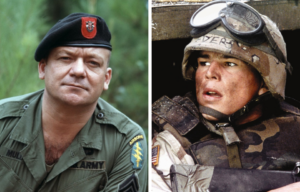
Looking at U.S. Army Rangers and Green Berets isn’t about declaring one superior to the other, but about recognizing how differently each unit is designed to fight. Both belong to the highest tier of military forces, marked by extraordinary training, bravery, and discipline, yet their missions and methods set them apart.
Rangers are optimized for fast-moving, high-impact operations, with a strong emphasis on direct combat, airborne assaults, and precision raids. Green Berets, by contrast, concentrate on unconventional warfare—building and advising partner forces, carrying out sensitive missions behind the scenes, and influencing conflicts through strategy rather than sheer force.
For those weighing a future in the military, understanding these contrasts is essential, as it helps align personal strengths and ambitions with the unit best suited to them.
Army Ranger vs Green Beret

Both the U.S. Army Rangers and Green Berets belong to the nation’s most elite military units, yet they are built for very different purposes. Rangers function as highly mobile light infantry, trained to deploy quickly and strike hard in missions such as raids, airfield assaults, reconnaissance operations, and combat rescues. Their famous creed, “Rangers Lead the Way,” captures their role as shock troops designed to seize the initiative in intense frontline combat.
Green Berets, by contrast, typically work in tight-knit 12-man detachments, often operating deep in hostile territory or in sensitive political environments. Their expertise lies in unconventional warfare, including insurgency support, counterterrorism, foreign internal defense, and the training of partner forces. The motto “De Oppresso Liber,” meaning “To Free the Oppressed,” reflects their emphasis on enabling local allies and undermining adversaries through indirect and adaptive approaches.
Though both units fall under U.S. Special Operations Command and share overlapping skills, their strengths differ in purpose. Rangers deliver rapid, overwhelming force, while Green Berets bring long-term strategic influence and cultural fluency. Together, they provide complementary capabilities that allow U.S. forces to respond effectively across a broad spectrum of conflicts.
Army Ranger training requirements

The differences between U.S. Army Rangers and Green Berets start with how you get in. Any active-duty Army soldier who’s at least 18 years old can apply for Ranger School—there aren’t any special requirements. Even civilians can sign a contract that lets them try the tests right after Basic Training.
Ranger School is tough and well-respected, but just earning the Ranger Tab doesn’t mean you’re officially part of the 75th Ranger Regiment. To get there, you also have to pass the Ranger Assessment and Selection Process (RASP).
Green Beret training requirements

Training to become a Green Beret is significantly more difficult. Active soldiers wanting to join the Special Forces must complete at least three years of service with the Army before applying and have reached the rank of E-3 – or private first class. Troops who haven’t previously served can sign an 18X contract, which allows them to try their hand at becoming Green Berets as soon as they finish Basic Training and the Basic Airborne Course (BAC).
Active soldiers who are approved to begin the selection process must take the two-week Special Operations Preparation Course (SOPC). The physical conditioning course helps prepare them for the rigors of the Special Forces Qualification Course (SFQC) – better known as the “Q” Course.
Candidates must attend the Special Forces Preparation Course (SFPC) to test their physical and navigational skills. It’s purposely challenging to weed out those who aren’t yet prepared for the Q Course. Those who pass must also go through Special Forces Assessment and Selection (SFAS), a three-week evaluation of “intelligence, physical fitness, motivation, trainability, judgment, and influence.”
It’s only after these hurdles that soldiers may move onto the Q Course.
Ranger Assessment and Selection Process (RASP)

Special Forces Qualification Course (SFQC)

For a soldier to become a Green Beret, they must endure the Q Course, a one-to-two-year process that’s split into six phases to churn out skilled Special Forces members.
The first phase is course orientation and history. Lasting seven weeks, it teaches candidates the core mission and tasks of the US Army Special Forces and the various military occupational specialties (MOS). The second focuses on language and culture, with soldiers expected to become experts in the language and culture they’re assigned, through 18-24 weeks of training and education.
The third is small-unit tactics and lasts for 13 weeks. Throughout, soldiers become skilled marksmen, and are trained in urban warfare operations, sensitive exploitation procedures, and complete Survival, Evasive, Resistance, and Escape (SERE) training.
The fourth phase – MOS training – assigns candidates into their respective fields: detachment commander, engineer sergeant, medical sergeant, weapons sergeant or communications sergeant. The fifth consists of the Unconventional Warfare Culmination Exercise – Robin Sage, which takes four weeks. The soldiers are dropped into a fictional environment of political instability, and told to plan and apply their skills to overcome the challenges of overthrowing a faux-guerrilla regime.
More from us: There’s a Big Difference Between the FBI and CIA
The sixth and final phase of the Q Course is what all candidates hope to reach: graduation. Here, those who’ve successfully completed their training are awarded their green beret, officially making them members of the Army’s Special Forces.