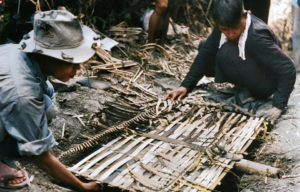
Bow trap

The bow trap was a simple but effective weapon used by the Viet Cong in the early stages of the Vietnam War. A bow was stretched and ready to shoot, then connected to a tripwire. When an American soldier triggered it, the bow went off right where they were standing, hitting them in the chest.
In some cases, the guerrillas set up this trap in a small pit. Here, the bow was tilted upward, causing the arrow to hit the soldier in the legs instead.
Punji sticks

Punji sticks, also known as punji stakes, were a common booby trap deployed by the Viet Cong. The sharpened bamboo, wooden and sometimes metal stakes were often coated in feces or urine, with the goal of causing an infection in their victim. They could also be coated with poisonous substances from animals and plants.
Punji sticks were placed pointing upright at the bottom of a hole, before being covered with material that would camouflage them. When a US soldier broke through the flimsy cover over the hole, they would step on the spikes at the bottom and suffer injuries to their feet and legs.
This particular booby trap could be made worse in two different ways. The first was installing them at a downward angle, along the sides of the hole. When these extra stakes were added, it became difficult for the victim to get themselves out without causing further injury to themselves. This often resulted in the slowing down of their unit while efforts were made to free them.
A second way was by digging another hole next to the one equipped with the punji sticks, with the aim being to trap a second combatant with little additional effort. When a soldier came to rescue his injured comrade, he’d fall into the adjacent hole and become trapped.
Along with physically injuring American troops, punji sticks were also effective at hurting the overall morale of those serving within Vietnam’s dense jungles.
Bamboo whip

Bamboo whips were another cruel booby trap used by the Viet Cong. A bamboo pole, pulled back under high tension, was connected to a tripwire. The pole was outfitted with foot-long spikes, and when the tripwire was triggered, it would snap forward, impaling the person who set it off.
As reported by We Are The Mighty, the pole and its spikes could reach speeds of up to 100 MPH. Similar to punji sticks, the spikes could be coated with toxic substances to weaken the victim’s ability to recover.
Swinging mace

The swinging mace operated similarly to the bamboo whip, but instead of being fixed to a stationary post, it featured a 24-inch spiked ball crafted from clay, wood, or metal. Suspended from a frame and set off by a tripwire, the device often weighed more than 40 pounds.
Regarded as one of the most dangerous traps used by the Viet Cong, the mace swung downward when triggered, relying on gravity to deliver devastating blows. Strikes to the head or torso frequently proved fatal or caused catastrophic injuries, earning it a fearsome reputation among U.S. troops as an exceptionally lethal and intimidating weapon.
Tiger trap

The tiger trap was another Viet Cong booby trap that, like the swinging mace, caused significant injury to a soldier’s upper body. The trap was sprung when the intended victim triggered a tripwire, causing a wooden plank imbued with metal spikes to fall on them.
This was made all the more brutal by the addition of weighted bricks or other objects on the board.
Snake pit

Snake pits were primarily used within the Viet Cong’s tunnel systems.
A poisonous snake would be attached to a piece of bamboo, and when released on the victim would place the reptile in the perfect location to attack. Snake pits were encountered by American “tunnel rats,” but the Viet Cong would put snakes in other locations, too, such as in their bags or in old weapons caches.
Bamboo pit vipers were a common snake used by the Viet Cong. Within a few minutes of being bitten, the flesh surrounding the bite turned necrotic, swollen and extremely painful. However, the Malayan krait was the most infamous, earning the nickname, the “two-step snake,” sometimes mischaracterized as the “three-step snake.” This is rooted in a myth that a soldier bitten by one was killed in the short time it took him to move two steps.
Cartridge trap

Cartridge traps were ingeniously simple but cruelly effective, resembling the concept of punji sticks. A live bullet was placed inside a bamboo tube, positioned above a nail driven into a wooden block that acted as a rudimentary firing pin. The entire mechanism was then camouflaged with soil or foliage to blend seamlessly into the environment.
When an unsuspecting soldier stepped on the hidden device, the pressure forced the nail into the cartridge, firing the round straight into the foot. These traps earned the grim moniker “toe-poppers.” Injuries varied depending on the bullet’s size—smaller rounds could cause permanent disability, while larger ones carried the risk of being fatal.
Grenade-in-a-can

The so-called “grenade-in-a-can” trap was as simple as it was deadly. An armed grenade—with its safety pin already removed—was placed inside a can that held the striker lever tightly in place. A tripwire was attached to the grenade, and once triggered, the wire pulled it free from the can, releasing the striker and setting off the blast.
These makeshift weapons could be arranged in a variety of ways. Sometimes a single can was fixed to a stake, while in other cases two cans were secured on opposite sides of a trail, connected by a taut tripwire. They were often hidden in shallow streams or near the concealed entrances of Viet Cong tunnel complexes, where they posed an immediate and lethal danger to American and allied soldiers moving through the area.
Rigging war trophies

These booby traps were created based on the fact that American troops enjoyed capturing the flags of their enemies. When Viet Cong guerrillas were forced from their bases, they’d rig their flags with explosives, which detonated when the US soldiers took them down.
More from us: Cessna A-37 Dragonfly: The Forgotten Legend of Vietnam
The Viet Cong knew the Americans also enjoyed taking other items as war trophies. As such, they rigged them with similar explosives, so that, if the enemy combatants wanted to take anything from abandoned camps, the explosives would detonate, causing additional casualties.