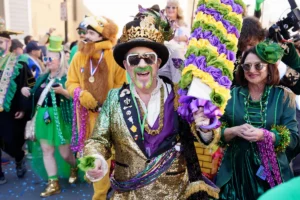
Mardi Gras has a reputation for being unstoppable. Even people who’ve never set foot in New Orleans know the basics: parades, music, masks, and a city that seems to run on celebration.

But history has a way of interrupting even the most “untouchable” traditions. And on one Mardi Gras Day—the same date we’re marking this year—New Orleans went quiet for a reason that had nothing to do with weather, budgets, or bad luck. It was war.
Mardi Gras Today—And the Strange WWII Echo Behind Feb 17


On Feb. 17, the U.S. celebrates Mardi Gras in full color: brass bands, parades, costumes, and a city that seems to run on pure sparkle. But here’s the twist most people don’t expect: Feb. 17 was also Mardi Gras Day in 1942—and that year, New Orleans was already learning how quickly war can change what “normal” even means.
Just 10 weeks after Pearl Harbor, the United States was still reeling, and the home front was shifting into a new gear: rationing, recruiting, factory schedules, blackout drills, war bonds—the whole country reorganizing around a single priority.
And in New Orleans, that shift came with an unthinkable announcement: the city canceled official Carnival celebrations.
“Canceled for the Duration”: When the Good Times Didn’t Roll
Mardi Gras doesn’t just happen. It takes months of planning, supplies, labor, and money. In late 1941, preparations were already underway—floats ordered, costumes planned—when city leaders called it off. One contemporary report described floats being covered and costumes going back into storage, waiting for “a more carefree day.”
The cancellation wasn’t a one-off. Major parades were effectively halted through the war years—1942 to 1945—because the mood, resources, and national focus had changed.
That doesn’t mean New Orleans stopped being New Orleans. People still found ways to gather, to laugh, to keep traditions alive in smaller, more subdued forms. But the city’s biggest party was no longer the headline—the war was.
The War Behind the Beads: New Orleans as an Arsenal City
If Mardi Gras is New Orleans’ most famous export, WWII-era New Orleans had another: industrial muscle. The city’s waterfront and factories mattered—especially through companies like Higgins Industries, which built landing craft that became essential to amphibious warfare.


Higgins’ workforce exploded during the war—growing to over 20,000 workers by 1943. Even more striking for the era: the Higgins’ workforce in New Orleans was racially integrated, employing women and Black workers alongside white workers in large numbers, all paid according to job rating. That’s a home-front story hiding in plain sight—one that sits right behind the city’s Carnival mythos.
So while parades paused, the city’s energy didn’t vanish. It was redirected—toward production lines, shipping schedules, and the grinding logistics of a global conflict.
Why This WWII Mardi Gras Story Still Hits in 2026


Mardi Gras is often sold as “escape,” but historically it’s also been a cultural barometer: it swells when times are good, and it tightens when the world turns hard. WWII proved that even America’s loudest traditions can be muted when national survival becomes the main event.
And here’s what makes the WWII shutdown feel even bigger in hindsight: New Orleans almost never pulls the plug on Mardi Gras parades. After the war years, the next time the city saw a comparable “no official parades” situation was 1979, when a police strike forced cancellations and pushed some parades to neighboring areas. Then came the modern shocker—COVID-19, when New Orleans banned parade permits for 2021 to avoid mass-crowd spread. Different crises, same result: the city didn’t lose its spirit, but the big public machinery of Carnival had to pause.
So if you’re watching the parades roll on Feb. 17, there’s an odd bit of perspective in the confetti: New Orleans has seen a Mardi Gras Day on this exact date before—when the streets were quieter, the drapes stayed drawn over the floats, and the city quietly went to work for the war.
Did you know that:
The Louisiana Native Guards Were The First African-American Civil War Unit To Go Into Battle ?