Photo Credit: U.S. Navy / Naval History and Heritage Command / Wikimedia Commons / Public Domain (Colorized by Palette.fm)
On May 28, 1958, the USS Stickleback (SS-415) was lost in a tragic peacetime accident during what should have been a routine training exercise off the coast of Hawaii.
Though the submarine never saw combat, its early service placed it on the edge of history—its first deployment occurred during the same period as the atomic bombing of Hiroshima in August 1945. After the war, Stickleback was decommissioned, only to be brought back into service for the Korean War, where it played a crucial role training and preparing a new generation of submariners.
Disaster struck during a postwar training drill when Stickleback surfaced near the destroyer escort USS Silverstein. A sudden mechanical failure left the sub unable to maneuver, and within seconds Silverstein collided with it. The crew escaped safely, but Stickleback sank soon after.
Even in calm waters, far from any battlefield, the loss of the Stickleback underscored the unforgiving risks faced by those who serve beneath the sea.
USS Stickleback (SS-415) following World War II
USS Stickleback (SS-415), 1945. (Photo Credit: US Navy / Wikimedia Commons / Public Domain)
On June 26, 1946, following the Second World War, the USS Stickleback was decommissioned. However, the submarine was recommissioned on September 6, 1946, serving as a training ship out of San Diego. In November 1952, the vessel was sent to Mare Island Naval Shipyard to be converted into a GUPPY IIA-type submarine.
After her conversion, Stickleback joined Submarine Squadron 7 out of Pearl Harbor. Between February-July 1954, she saw service supporting the United Nations (UN) forces in Korea. Following the conflict, the vessel participated in a number of exercises and training missions.
Not-so-routine anti-submarine warfare exercise
USS Stickleback (SS-415), 1950s. (Photo Credit: U.S. Navy / Wikimedia Commons / Public Domain)
During an anti-submarine warfare drill near Oahu, Hawaii, the USS Stickleback operated in coordination with the destroyer escort USS Silverstein (DE-534) and a torpedo retriever. What began as a routine training scenario quickly turned critical.
As part of the exercise, Stickleback simulated a torpedo strike on Silverstein. However, in the midst of the maneuver, the submarine suffered a sudden loss of power, causing it to lose buoyancy and plunge uncontrollably into the depths of the Pacific. According to reports, the sub descended to a staggering depth of 800 feet—far beyond its designed crush depth—putting the crew and vessel in extreme danger as emergency recovery efforts began.
Crisis averted… for now
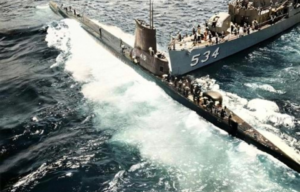
USS Silverstein (DE-534) off the coast of Pearl Harbor, Hawaii, 1955. (Photo Credit: BMC Albert Curry, U.S. Navy / NavSource / Wikimedia Commons / Public Domain)
If not for the crew’s rapid response, the USS Stickleback might have plunged to a depth from which no one could have survived. When the submarine began an uncontrolled descent during the exercise, the sailors executed emergency procedures flawlessly—blowing the ballast tanks to halt the fall and force the vessel back to the surface. Their quick thinking averted catastrophe.
Yet breaking the surface created a new and unexpected danger.
As Stickleback rose, the destroyer escort USS Silverstein—also involved in the drill—found itself on a collision course. With almost no time to react, Silverstein’s crew threw engines into reverse and attempted a hard turn, but the distance was too short. The destroyer escort struck Stickleback on the port side, tearing open the pressure hull. Water rushed into key compartments, sealing the submarine’s fate despite every effort to save her.
Disaster strikes the USS Stickleback (SS-415)
Collision between the USS Stickleback (SS-415) and Silverstein (DE-534), 1958. (Photo Credit: U.S. Navy / Naval History and Heritage Command / Wikimedia Commons / Public Domain)
The USS Stickleback began taking on water. With little they could do, the 82 crewmen aboard were transferred to the torpedo retrieval ship involved in the exercise. Attempts to save the vessel involved the USS Silverstein, along with the USS Sturtevant (DE-239), Sabalo (SS-302) and Greenlet (ASR-10), securing lines around her.
Despite their efforts, the submarine continued to flood. At 6:57 PM on May 29, it was reported that Stickleback “sank in 1,800 fathoms of water.” Just a month later, she was removed from the Naval Register.
Discovering a wreck at the bottom of the ocean
Lt. Cmdr. Roy Robison, skipper of the USS Stickleback (SS-415), and other crew members, 1952. (Photo Credit: Los Angeles Examiner / USC Libraries / CORBIS / Getty Images)
In 2020, the Lost 52 Project, a private company dedicated to locating all American submarines lost during World War II and the four that sunk during the Cold War, began a search for the USS Stickleback. This marked the company’s sixth discovery, achieved through the use of sonar-based imagery and robotics technology.
Bob Neyland, head of the Naval History and Heritage Command’s Underwater Archaeology Branch, stated Stickleback‘s discovery provided “an opportunity to remember and honor the service of our sailors and marines.”