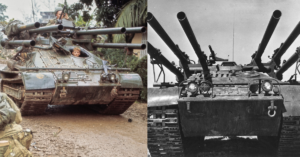
In the early 1950s, the United States sought a lightweight, air-transportable tank destroyer. Previous attempts during World War II had been limited by the cargo capacity of transport aircraft, which forced compromises in armor and firepower, rendering the vehicles largely ineffective against enemy tanks. The resulting project—a joint effort by the US Army and Marine Corps—produced the M50 Ontos, though ultimately only the Marines would deploy and operate the unusual vehicle.
The name Ontos, Greek for “thing,” aptly reflected the tank destroyer’s unconventional design. Compact yet powerful, the M50 was intended to be air-dropped into battle, offering both flexibility and mobility. However, developing such a vehicle presented engineering challenges. Designers calculated that the tank destroyer would need to weigh between 10 and 20 tons to remain air-transportable while still maintaining sufficient combat effectiveness.
The M50 Ontos

The M50 would use a small, low-profile fully-tracked hull and an enclosed compartment for the crew. As it needed to be moved by air, thin armor protection was one of the simplest ways to keep the weight low. Subsequently, the M50 only had 13 mm on the hull (about the same as a WWI Mark 1 tank) and just 6.5 mm on the underside.
But the M50’s showstopper was its main armament of six 106 mm recoilless rifles. Well, actually, they were 105 mm recoilless rifles but were named 106 mm to avoid confusion with the previous M27 recoilless rifle.
The vehicle was so small and light that a conventional anti-tank weapon would recoil too violently, so a recoilless rifle was used instead. Recoilless rifles use a clever technique to balance out most of the recoil forces generated when firing by venting some of the propellant gasses out the rear of the weapon to counteract the recoil. This allows the rifle to fire a much larger caliber round than conventional weapons of a similar size and weight.
Each could be fired individually, or in one single shot. While undergoing trials at the Aberdeen Proving Ground, an M50 fired all six rifles at once, blowing the bricks out of a nearby building while also shattering glass on nearby parked cars.
The guns were mounted to a small semi-traversable turret that could rotate up to 40 degrees on each side. It could elevate the guns up 20 degrees, and depress them 10 degrees. It lacked a complex targeting system, so the M50 used .50 caliber ranging guns on the rifles that had similar ballistic performance to the main armament. The gunner would fire a ranging round, which glowed brightly on its way to the target, emitting a puff of white smoke when it arrived. This would then be used as an aiming reference.
It was powered by a 5 liter inline 6 GMC engine that provided the vehicle with 145 hp. Despite its low power, the M50 was highly mobile and had a top speed of 30 mph, as it weighed just 8,600 kgs.
Tested, then rejected
When the M50 Ontos completed testing in 1955, the US Army rejected it. They considered the vehicle as too lightly armored (only capable of stopping .50 caliber rounds at most), too small, which made it cramped for the crew, and it didn’t carry enough ammunition. But the Army’s main issue with the vehicle was reloading the rifles. To reload, a crew member had to exit the vehicle, exposing themselves to enemy fire. The Army deemed this unacceptable. The US Marines were impressed though and ordered nearly 300.
Impressive service

Although the Army rejected the M50, it actually served with great success for the Marines. The Vietnam War was where it really shined.
It was designed as a tank destroyer, but the Marines used it as a highly mobile fire support platform that could relocate around the battlefield quickly and providing devastating fire with its six recoilless rifles.
Its portability meant it could be taken almost anywhere and move through the jungle much easier than other heavier vehicles. During Vietnam, the CH-53 Sea Stallion helicopter arrived in service with the US and was able to carry the M50 underneath.
Against fortifications or buildings, the M50 could fire High Explosive Squash Head (HESH) rounds, which were also useful for creating new entrances in walls in urban warfare. It was particularly deadly against mass-formations of soldiers, where it would fire “beehive” anti-personnel rounds, which are essentially super-sized shotgun rounds.
The US’ enemies in Vietnam quickly learned to fear the M50, and would often retreat at the sight of one.
Although it was extremely useful, the M50 Ontos would be removed from service in 1969.
End of the road for the “Thing”

The drawbacks the Marines had accepted during development would eventually prove significant in combat. The large back-blast produced by the Ontos’ recoilless rifles posed a danger to nearby troops, while the exposed reloading process placed the loader at serious risk. Its limited ammunition storage further made the vehicle impractical in prolonged engagements.
Yet the most critical issue was survivability. The M50’s thin armor offered almost no protection against larger-caliber weapons or even heavy shrapnel, and anti-tank mines were particularly deadly due to the vulnerable belly plating. If the vehicle were damaged, its ammunition was highly susceptible to catastrophic explosions.
Despite these limitations, the Ontos often performed far better than anticipated, striking fear into enemy forces. Col. Stanley S. Hughes, commander of the 1st Marines at Hue, remarked, “If any single supporting arm is to be considered more effective than all others, it must be the 106 mm recoilless rifle, especially the M50 Ontos.”