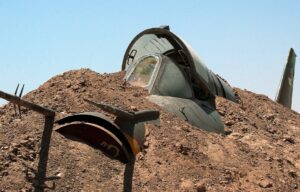
The desert conceals many relics of past wars, but stumbling upon a Mikoyan-Gurevich MiG-25 half-buried in the sand is something extraordinary. Known to NATO as the “Foxbat,” this Soviet-built interceptor was engineered for one purpose: absolute speed. Capable of outrunning nearly any aircraft of its era, the MiG-25 dominated the high-altitude arena during the Cold War. Its blistering performance made it a prized asset not only for the Soviet Union, but also for countries like Iraq, Syria, India, and Algeria.
Among its variants, the MiG-25RB—nicknamed the “Foxbat-B”—stands out as a hybrid reconnaissance and strike aircraft. Designed for long-range intelligence missions, it could also carry up to eight 500-kilogram bombs, allowing it to function as a high-speed bomber when needed. This dual capability, combined with its unmatched velocity, cemented the MiG-25RB as one of the most versatile and formidable aircraft of its time.

This is the same interceptor shown in the picture above. American troops uncovered it at the start of the Iraq War. In April 2003, they unearthed it from deep underground at Al Taqaddum Air Base, which is in Iraq’s western desert.
Although intelligence reports indicated that items were buried in the area, finding this aircraft was still a surprise. As former Defense Secretary Donald Rumsfeld put it, “We’d heard a great many things had been buried, but we had not known where they were, and we’d been operating in that immediate vicinity for weeks and weeks and weeks… 12, 13 weeks, and didn’t know they were [there].”

More from us: US Naval Aviators Once Complained That NASA Pilots Were Bullying Them
Why hide the jets instead of flying them into combat? Before the invasion, Iraq fielded one of the largest air forces in the Middle East, complete with advanced fighters, reinforced hangars, and upgraded support infrastructure. But once coalition aircraft established overwhelming air dominance, Iraqi commanders understood their planes had no chance in a direct confrontation. Rather than send their pilots and aircraft into certain destruction, they resorted to burying jets in the desert—a last-ditch effort to preserve what remained of their air fleet in the face of an unstoppable aerial onslaught.