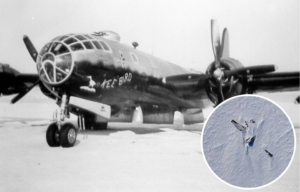
On February 20, 1947, Lieutenant Vern H. Arnett led an 11-man U.S. Air Force crew on what was planned as a routine secret mission. This marked their seventh flight of its type, with the goal of crossing the Geographic North Pole and returning safely to Ladd Field, Alaska. The aircraft carried sufficient fuel to complete the expected 26-hour round trip under normal circumstances. Yet unexpected developments during the journey turned a standard assignment into a remarkable and unforgettable ordeal.
An ill-fated mission

The mission was expected to last between 12-20 hours, with the Boeing B-29 Superfortress Kee Bird scheduled to land at Ladd Field at 10:00 AM. What wasn’t planned, however, was an emergency landing in northwestern Greenland— which is what happened.
On February 21, 1947, the Kee Bird, belonging to the 46th Reconnaissance Squadron, had to make an emergency landing on a frozen lake. The 46th Squadron was based at Ladd Field near Fairbanks, Alaska, and its flights were focused on improving polar navigation, mapping the Arctic, studying weather patterns, testing men and equipment in extreme Arctic conditions, and conducting long-range aerial photography for intelligence purposes.
Unofficially, the squadron was also on the lookout for any Soviet military activity in the remote Arctic.
After the crew safely evacuated, they were rescued, but the B-29 was left behind, abandoned in the Arctic tundra, where it remained untouched for 47 years.
Attempting to rescue the B-29 Superfortress Kee Bird

In July 1994, a group of aviation restoration experts known as the Kee Bird Limited Liability Company, led by veteran pilot Darryl Greenamyer, arrived at the crash site of a downed B-29 Superfortress deep in the Arctic. To their surprise, the aircraft—abandoned since 1947—was in far better shape than expected.
Confident they could restore it to flying condition, Greenamyer and his team brought in specialized tools and heavy equipment. Throughout the summer, they secured parts from U.S. military bases in Greenland, including a replacement engine, four new propellers, fresh tires, an engine hoist, and even a bulldozer to clear the snow-packed terrain around the crash site.
Their goal was clear: make the Kee Bird airworthy, take off from the frozen lakebed where it had crash-landed, and fly the historic bomber to Thule Air Force Base for further repairs—eventually bringing it back to the United States. But progress was soon halted by the brutal Arctic weather, which forced the team to pause their efforts.
It wasn’t until May 1995 that Greenamyer and his crew were finally able to return and continue their daring attempt to bring the Kee Bird back to life.
B-29 Superfortress Kee Bird becomes engulfed in flames

After months of meticulous restoration that had begun the previous year, Darryl Greenamyer’s B-29 Superfortress, Kee Bird, was finally ready for takeoff on May 21, 1995, from a frozen lake.
A bulldozer had cleared a makeshift runway through the ice and snow, and the engines thundered to life as turbines spun, signaling that the aircraft was prepared for flight—until a fuel leak appeared in the auxiliary power unit’s tank. The escaping fuel ignited inside the fuselage, quickly igniting a fire that soon engulfed the aircraft. Despite the crew’s frantic attempts to control the blaze, the flames consumed much of the fuselage and severely damaged the tail section. With the aircraft beyond repair, Greenamyer and his team were forced to abandon the ambitious recovery effort.
More from us: A Boeing B-29 Superfortress Carrying An Atomic Bomb Once Crashed In California
Contrary to expectations that the plane would slip beneath the thawing ice come spring, the Kee Bird remarkably remains perched on the frozen lake, where it still rests to this day.