In early 2026, the U.S.-Japan military alliance is described by officials as stronger and more united than ever, with the two countries deepening military coordination at every level. It’s one of the most important partnerships in the world.

But exactly 80 years ago tonight, the United States did something to Japan that dwarfs even the atomic bombs in terms of lives lost in a single night, and most people have no idea it happened. It has often been placed among the worst bombing campaigns of World War Two.
The Night Tokyo Burned

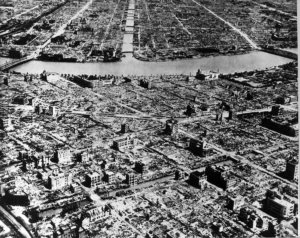
On the night of March 9–10, 1945, nearly 300 U.S. planes dropped 1,665 tons of incendiary bombs on Japan’s capital, igniting a firestorm that destroyed much of the city’s industry and killed between 90,000 and 100,000 people.
The operation was called Operation Meetinghouse. It is often cited as one of the most destructive acts of war in history — more destructive than the bombing of Dresden, Hiroshima, or Nagasaki.
The man behind it was General Curtis LeMay. His target was a three-by-four-mile area of Tokyo housing an estimated 750,000 people. American intelligence had determined the neighborhood was packed with small factories feeding Japan’s war machine, and that it was dangerously flammable.
They were right on both counts.
“A River of Fire”

The first B-29s dropped napalm and white phosphorus in a giant “X” pattern. Dry, windy conditions turned the resulting fires into a single, catastrophic firestorm, destroying almost 16 square miles of the city.
As well as those killed, hundreds of thousands of people were injured, and a million lost their homes.
Survivor Haruyo Nihei, who was just eight years old that night, later recalled the horror. “There was a strong wind and as I came out of the shelter, all I could see around us was fire,” she said. “I saw a baby on fire on a mother’s back. I saw children on fire, but they were still running.”
The Japanese later called it “The Night of the Black Snow.”
More Deadly Than the Atomic Bomb—So Why Don’t We Talk About It?

The bombings of Hiroshima and Nagasaki are more commonly remembered for the horrific use of new weapons of war. But the human toll of the firebombing of Tokyo is equally devastating. In Hiroshima, between 60,000 and 80,000 people were killed instantly. In Nagasaki, about 40,000. In Tokyo, 100,000 people lost their lives in a single night.
So why has Operation Meetinghouse been largely forgotten?
Historians point to several reasons: the atomic bomb was a new and shocking technology that captured the world’s imagination, and the morality of its use was immediately debated. The firebombing, by contrast, used conventional weapons — horrific in scale, but not novel in method.
As the Council on Foreign Relations has noted, conventional bombings accounted for far more civilian deaths in Japan than the nuclear weapons dropped on Hiroshima and Nagasaki. The Tokyo raid alone proves that point.
A Complicated Legacy
Today, that history sits quietly beneath one of the world’s strongest military alliances. A survivor, Shizuo Takeuchi, put it simply: “I don’t hate Americans and I don’t hold a grudge, but I do want future generations to know what happened here.”
On this 80th anniversary, that seems like the very least we can do.