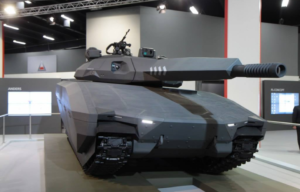
Photo Credit: Ministerstwo Obrony Narodowej / Polish Ministry of National Defence / Wikimedia Commons / Attribution
Countries regularly strive to update their military capabilities with the latest weaponry and armored vehicles. In 2013, Poland introduced the PL-01, a concept tank designed for direct fire support on the battlefield. Initial forecasts suggested large-scale production and operational deployment by the late 2010s; however, these ambitions were never realized, leaving the project’s long-term prospects unclear.
Development and unveiling
PL-01 concept tank. (Photo Credit: U.S. Army Maneuver Center of Excellence / Wikimedia Commons / Public Domain)
The PL-01 was developed by Polish company OBRUM, with support from the United Kingdom’s BAE Systems. It’s based on the CV90120-T, an export version of the Swedish Combat Vehicle 90. A direct fire support combat vehicle, it was designed with a similar layout to other modern main battle tanks (MBTs), and has the ability to also serve as a mine clearance vehicle, a tool for armored vehicle repair and as a command vehicle.
The PL-01 was officially unveiled to the public during the 2013 International Defense Industry Exhibition in Kielce, Poland. While there were rumors it could enter service as early as 2018, not a single PL-01 has left the factory. While some sources claimed the stealth tank could be delivered at some point in 2022, this never happened.
PL-01 specs
The PL-01 concept tank is based on the Swedish CV90120-T. (Photo Credit: Łukasz Golowanow / Konflikty.pl / Wikimedia Commons / Attribution)
The PL‑01 adhered to the conventional configuration of a main battle tank. The driver sat at the front of the hull, with the commander and gunner positioned nearby, while the rear compartment was designed to accommodate up to four infantry soldiers on shock‑absorbing seats to mitigate injuries from mines or improvised explosive devices.
Built on the reliable CV90 chassis, the vehicle featured a suspension system with seven roadwheels per side. Its rear-mounted, unmanned turret included an integrated active protection suite and was outfitted with two banks of smoke grenade launchers—four per side. Both hull and turret incorporated layered defensive measures, such as automated fire suppression and comprehensive protection against nuclear, biological, and chemical threats.
A 940‑horsepower diesel engine coupled with a torque converter powered the tank, giving it an estimated maximum speed of 43 mph on roads and around 31 mph over rough terrain. Operational range was projected to vary between roughly 160 and 310 miles depending on conditions and mission requirements.
Crew safety was a primary design consideration. The hull and turret were armored with modular ceramic‑aramid composites, supplemented with additional plates reportedly capable of withstanding blasts comparable to 10 kilograms of TNT. The design also allowed for add-on reactive armor to counter shaped-charge attacks such as HEAT rounds.
Equipped with modern communications, GPS navigation, and digital battlefield management systems, the PL‑01 also featured adaptive camouflage technology. Thermally controlled panels paired with infrared sensors were intended to modify the tank’s heat signature, helping it remain less visible to thermal imaging and complicating detection by radar or other sensing devices.
NATO-standard cannon and machine guns
PL-01. (Photo Credit: Ministerstwo Obrony Narodowej / Polish Ministry of National Defence / Wikimedia Commons / Attribution)
The PL-01’s main armament is a 105 mm or 120 mm gun mounted in a rear-positioned turret. Fitted with an autoloading system, it can put about six rounds downrange per minute and is capable of firing both standard and guided anti-tank munitions. Ammunition capacity totals 45 rounds, with 16 of those rounds kept in ready storage inside the turret.
The vehicle is armed with a 7.62 mm UKM-2000C as standard, and can be fitted with either an extra 7.62 mm weapon (with up to 8,000 rounds) or a heavier 12.7 mm machine gun (with about 400 rounds). Alternatively, the turret can accept a 40 mm automatic grenade launcher, supplied with 96 rounds, in place of the machine‑gun options.