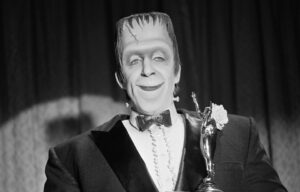
Fred Gwynne’s imposing height and resonant voice later defined iconic roles such as Herman Munster and Jud Crandall, yet his journey began well before the spotlight. Soon after graduating from high school, he enlisted in the U.S. Navy during World War II, where he served as a radioman and played his part in the Allied victory. Although he seldom reflected publicly on that chapter of his life, the structure and discipline of military service left a lasting imprint on his character.
After the war, Gwynne turned his attention to acting and gradually rose to prominence, winning both critical praise and devoted fans. Whether delivering broad comedy or quiet menace, his performances carried a steady confidence shaped by earlier experiences in uniform. Behind the elaborate costumes and unforgettable characters was a former sailor who had once monitored vital communications, guided by a sense of duty larger than himself.
Fred Gwynne’s early life

Some sources suggest he began studying portrait painting in the years before World War II. However, when the United States joined the conflict, he set aside his artistic pursuits to enlist in the US Navy.
Details about his military service are scarce, including the specific year he enlisted. It’s unlikely he joined immediately after the Japanese attack at Pearl Harbor, as he was only 15 at the time, though he could have potentially lied about his age to enlist.
Enlisting in the US Navy

It is known that Fred Gwynne served on the submarine-chaser USS Manville (PC-581), which was launched on July 8, 1942. Under the command of Lt. Com. Mark E. Deanett, the Manville was used as an escort and patrol ship throughout the war. Later, she was assigned to the Fifth Amphibious Force for the invasions of Saipan and Tinian in 1944. The Manville also played a role in rescuing two Allied pilots from a crashed Consolidated B-24 Liberator.
However, it remains unclear how much of this Gwynne experienced while serving as a radioman
Fred Gwynne’s Hollywood career

After completing his World War II service, Fred Gwynne took full advantage of the GI Bill and enrolled at Harvard University. There, he developed a host of new passions such as drawing cartoons for the Harvard Lampoon and performing on stage with the Hasty Pudding Theatricals. These experiences helped him refine both his artistic and theatrical talents.
Gwynne went on to enjoy a successful acting career that showcased his unique mix of charm, humor, and presence. While he’s best remembered as the lovable Herman Munster in The Munsters, where his towering figure and comedic timing won over audiences, he also made a name for himself earlier as the straight-laced Officer Francis Muldoon in Car 54, Where Are You? (1961-63)—a role that first put him in the spotlight.
His next big film role was Pet Sematary

Fred Gwynne was more than just an actor

Fred Gwynne was more than just a familiar face on screen—his creativity spanned multiple disciplines. During his college years at Harvard, he developed a strong passion for singing, which he picked up in university. He became a member of the prestigious Harvard Krokodiloes, the university’s acclaimed a cappella group.
Beyond performing, Gwynne explored storytelling through children’s books as an author and illustrator of whimsical titles that played on kids’ literal interpretations of language. Works like A Chocolate Moose for Dinner, The King Who Rained, and The Sixteen Hand Horse delighted young readers and earned him a place on bestseller lists.
His artistic expression also extended to painting. Gwynne’s visual art was showcased in galleries, and in 1989, he held his first solo exhibition, earning recognition in the fine art world as well.
From television and theater to publishing and painting—not to mention his service in the U.S. Navy—Gwynne led a richly varied life. He died of pancreatic cancer on July 2, 1993, at his home, leaving a multi-faceted legacy that continues to resonate today.