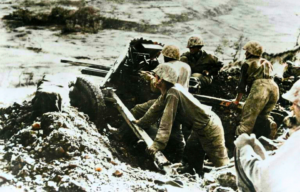
Taking the battle to the southern part of Okinawa

The Battle of Okinawa began on April 1, 1945, with the largest amphibious landing of the Pacific Theater during the Second World War. The plan was to capture Kadena Air Base, from which Operation Downfall would be launched on the Japanese home islands.
When the American troops landed on Okinawa, aided the US Navy’s Fifth Fleet, they split up. The 96th and 7th Infantry Divisions moved toward the southern part of the island, unaware the Japanese were lying in wait. As they neared Shuri, they encountered a defensive triangle set up by enemy commander Lt. Gen. Mitsuru Ushijima. What occurred was a fierce battle that saw both sides suffer heavy losses, with the Americans capturing the area that May.
Taking Kakazu Ridge

Fighting for control of Kadena and Yomitan Air Bases

Within hours of landing, both the Kadena and Yomitan Air Bases were captured. This was a great feat for the Americans and set in motion the second stage of the operation, allowing for the northern region of Okinawa to be captured early into the battle. As well, the Motobu Peninsula, the center of the Japanese soldiers’ defenses, was taken by the 6th Marine Division.
Next up was Mount Yaedake, which proved a tough fight, due to the rocky and wooded terrain. Still, the Americans had it cleared by April 18. This was followed by Operation Gi-gou, which saw the Japanese send Giretsu Kuteitai Commandos to take Yomitan. While they were able to cause substantial damage to the base, all were killed without capturing it.
Naval Battle of Okinawa

While much of the Battle of Okinawa took place on land, a large portion of the fighting also took place off the coast. Soon after the Allies landed on the island, the Japanese launched kamikaze attacks that caused tremendous damage to the US Fifth Fleet. When April 6, 1945, came around, 400 aircraft took off from Kyūshū, signaling the true beginning of the intense aerial assaults.
The next day, the Japanese launched Operation Ten-Go, led by the battleship Yamato. The last major Japanese naval operation in the Pacific, it involved 10 vessels on what, for many, would be their final actions of the war. However, the Americans were able to intercept the fleet, launching an effective airborne counterattack that sunk Yamato and five other enemy vessels.
Over the course of the naval battle, nearly 2,000 kamikaze aircraft attacked American positions around Okinawa. While no major US vessels were sunk, several smaller warships were, while 386 suffered some form of damage. The Japanese lost 16 vessels, with the loss of Yamato inflicting the biggest blow.
In terms of aircraft, the Americans lost 763, while the Japanese saw 1,430 destroyed.
Bloodiest battle of the Pacific Theater

The Battle of Okinawa lasted 82 long days and, by the time it came to an end, had solidified itself as the bloodiest of the Pacific Theater. It’s difficult to ascertain an accurate number of deaths that were suffered, with most estimates putting the total into the hundreds of thousands: 12,520 Americans, 110,000 Japanese soldiers, and between 40,000 and 150,000 civilians.
While the intention was to launch Operation Downfall not long after, the Japanese surrender following the atomic bombings of Hiroshima and Nagasaki made it so the mission didn’t need to be undertaken.
More from us: Bell P-63 Kingcobra: The American Fighter-Turned-Soviet Tank Buster
As for the air bases that were captured during the battle, Kadena remains under American control as the largest and most active US Air Force base in East Asia. Yomitan was repaired after the engagement for use by US Navy, Marine and Air Force aircraft. It was closed in 1996 and, 10 years later, turned over to the Japanese government, which transformed it into a community complex.