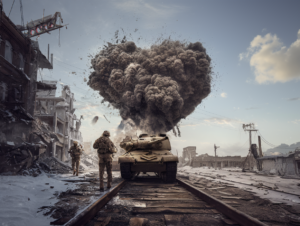
Valentine’s Day is usually framed as the softest square on the calendar—cards, candy, and romantic clichés. But if you zoom out, February 14 has some surprisingly sharp edges. Behind the heart emojis is a timeline that runs through emperors, battlefields, propaganda, and even military codenames. Here are a few of the strangest (and most human) connections between Valentine’s Day and war history—the kind you won’t find in the chocolate aisle.

From a Roman-era execution to trench valentines and a WWII “Valentine’s Day” bombing, February 14 has been tangled up with conflict for centuries, and we’ll see just how here.
The Original Valentine Was a Casualty of Empire

The popular “St. Valentine” story is messy because there were multiple early Christian figures with that name. Still, the broad tradition points to a 3rd-century Roman priest whose death became associated with February 14, during the reign of Emperor Claudius II. In one widely repeated account, Valentine was executed around A.D. 270.
Claudius II was a soldier-emperor fighting to hold the Roman world together. Early Christianity often collided with state power, and martyr stories—however embellished later—are reminders that “politics + war” isn’t just armies marching. Sometimes it’s a single prisoner facing the wrath of an entire empire.
World War I: When “Be My Valentine” Meant “Please Write Back”

Fast-forward to the Western Front and Valentine’s Day becomes something else entirely: a morale lifeline.
During World War I, soldiers sent lace-embroidered postcards and love notes from the trenches—tender, funny, and sometimes painfully sincere. These weren’t just cute souvenirs; they were emotional gear, a way to stay anchored to home while living inside mud, shellfire, and uncertainty.
It’s also a reminder that war, more than strategy and weapons, is waiting, longing, and trying to remain a person when everything around you is built to dehumanize.
World War II: A Valentine’s Day Bombing That Wasn’t Meant to Happen

February 14, 1945, lands in the middle of the final, brutal stretch of WWII in Europe—and it carries one of the most unsettling “Valentine’s Day” footnotes: the bombing of Prague by U.S. forces.
Multiple accounts describe the raid as the result of a navigation error, with Prague hit on the same day major bombing operations were underway elsewhere. Hundreds of civilians were killed, and the event left scars on the city for decades.
It’s a sobering contrast to the holiday’s modern branding: the same date that sells romance can also mark tragedy—especially in total war, where mistakes don’t stay small.
“Operation Valentine”: When War Borrowed the Language of Love
Militaries love codenames—and sometimes they pick ones that feel wildly out of place.
One example: “Valentine” as a WWII-era operation name connected to the Faroese islands in 1940, described as a preventive “friendly” occupation to block German moves.
Even if the name choice wasn’t meant to be cute, it shows how war language can be oddly detached from lived reality. The codename sounds like roses. The operation is about geography, shipping lanes, and power.
Why This Matters: Valentine’s Day Is Also a Memory Day

The strangest part of Valentine’s Day’s war connections isn’t that conflict shows up on the calendar—it’s how ordinary people kept trying to build tenderness inside it.
A Roman prisoner becomes a symbol. A WWI soldier mails a delicate postcard from a muddy trench. A city in WWII absorbs the cost of an error. A military office stamps “Valentine” onto a plan.
So if Valentine’s Day feels overly commercial now, war history offers a different lens: February 14 has long been a day when humans try—sometimes desperately—to insist on love, connection, and meaning, even in the shadow of violence.
Here are some more war history moments inextricably linked to February 14th:
- Fighting in the Desert – The Battle for Sidi Bou Zid, Saint Valentine’s Day, 1943
- German Counterattack at Sbeitla – The Valentine’s Day Offensive
And one cute Valentine’s Day love story that had its roots in WWII: