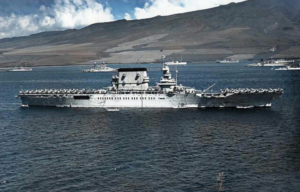
USS Lexington (CV-2)

USS Lexington began life as a very different kind of warship. Originally planned as a battlecruiser in 1916, her fate changed after the Washington Naval Treaty of 1922 halted construction of ships of that type. Rather than dismantle the incomplete hull, the U.S. Navy converted Lexington into one of its earliest operational aircraft carriers. She was commissioned on December 14, 1927, and soon became known affectionately as “Lady Lex,” a nickname that reflected the admiration of her crew. Because she entered service during a largely peaceful period, Lexington played a major role in refining carrier operations and naval aviation tactics, including taking part in simulated attacks on Pearl Harbor.
Lexington also proved useful far beyond her military duties. During a severe drought in 1929, the carrier helped provide electricity to Tacoma, Washington. In 1931, she participated in relief efforts following the 1931 earthquake in Managua, Nicaragua, transporting medical personnel and badly needed supplies to assist those affected by the disaster.
The USS Lexington‘s (CV-2) service during World War II

During the Japanese attack on Pearl Harbor in December 1941, the USS Lexington was en route to Midway Island, transporting fighter aircraft. Swiftly recalled to base, her first mission of World War II initially involved an attack on Japanese targets in the Marshall Islands, aimed at diverting attention from the besieged Wake Island. However, the surrender of the US forces stationed there negated the need for such action.
In early 1942, Lexington was deployed to the Coral Sea, where she spent the majority of her remaining service. Positioned to counter Japanese advancements in the region, she, along with the USS Yorktown (CV-5), engaged enemy shipping near New Guinea.
Following a refit at Pearl Harbor, Lexington returned to the Coral Sea that May. Her timely return proved crucial, coinciding with the Japanese launch of Operation Mo just days later.
Battle of the Coral Sea

The commencement of Operation Mo signaled the onset of the Battle of the Coral Sea, where the USS Lexington, Yorktown, and their carrier aircraft defended the area against attacking Japanese vessels. Intercepting their plans to seize Port Moresby, this engagement was unique in that it marked the first sea battle where the combatant ships didn’t come within range of each other. Instead, they waged the battle using their aircraft.
On May 7, 1942, Lexington‘s aerial fleet sank the Japanese light aircraft carrier Shōhō. Deploying bombs and torpedoes, they initiated the attack by setting fire to the aircraft on the vessel’s flight deck, subsequently disabling her power and steering. With the continued assault, Shōhō began to flood. With the assistance of Yorktown‘s aircraft, the carrier ultimately sank at 11:31 AM, accompanied by the famous call from Lt. Cmdr. Robert E. Dixon, “Scratch one flat top!”
A turn for the worse

Wreck of the USS Lexington (CV-2)

In the ensuing hours, relentless attacks persisted against the USS Lexington. Impressively, she managed to refuel a considerable number of her aircraft. However, at 2:42 PM, an explosion severed all power to the ship’s front, intensifying the fires that raged aboard the carrier. Capt. Frederick Sherman issued the order for the crew to abandon ship at 5:07 PM, ensuring everyone who could be evacuated was safely removed before he followed suit at 6:30 PM.
The difficult decision was made to scuttle Lexington to prevent the Japanese from seizing the vessel. Tasked with this mission, the USS Phelps (DD-360) launched five torpedoes, all of which found their mark, leading to the aircraft carrier’s sinking, along with 35 of her aircraft.
The majority of the crew successfully escaped, with reports indicating that 2,735 were evacuated, while 216 tragically lost their lives. Despite the heavy toll, the resolute defensive stand made by the USS Yorktown and Lexington bore immense significance. This stance thwarted the Japanese carriers from reaching New Guinea and Australia, thus preventing their involvement in the Battle of Midway.
The wreck of the USS Lexington (CV-2) is discovered near Australia

Although the USS Lexington’s (CV‑2) scuttling coordinates were documented in 1942, the carrier’s final resting place was undiscovered for decades. That changed on March 4, 2018, when an exhaustive six-month search finally pinpointed her resting place.