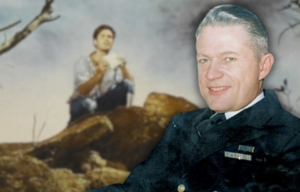
During wartime, it is nearly inevitable that people will push themselves to their limits, achieving acts of remarkable bravery and heroism. Individuals who accomplish such feats are typically celebrated. However, war also demands the testing and surpassing of other limits, often requiring individuals to face and overcome challenges far beyond ordinary imagination.
A prime example of this is George Ray Tweed, a radioman 1st class in the US Navy, who demonstrated extraordinary stealth and resilience by surviving and escaping the Imperial Japanese Army (IJA) on Guam for two years and seven months.
Japanese invasion of Guam

George Ray Tweed had been in the US Navy for 16 years when Japan invaded Guam in December 1941. In fact, he’d lived on the island with his family since mid-1939. Family of service members stationed on Guam had already been evacuated, so when the Japanese launched their attack on December 8, the only ones on the island were sailors and US Marines, along with a few nurses.
The numerically superior Japanese quickly swamped any resistance on the part of the Americans, with the garrison surrendering on December 10. However, six sailors decided not to give in. Instead of resigning themselves to spending the rest of World War II in a Japanese prison camp, they chose to flee.
Four of them were stationed at the Radio Communications Center, including Tweed. The other two were crewmen from the USS Penguin (AM-33), a minesweeper that had been sunk by the enemy at the start of the invasion.
George Ray Tweed refused to surrender to the Japanese

Upon hearing that the Americans had surrendered, George Ray Tweed and Radioman 1st Class Albert Tyson immediately escaped. Before departing, Tweed returned home to gather a few necessities, stuffing them into a pillowcase, while Tyson did the same. In their haste, however, both men forgot to bring one of the most critical supplies they would need to stay alive: water. On Guam, where sources of fresh water were scarce, this mistake posed a serious risk.
After pushing through dense jungle growth and suffering cuts from the thick vegetation, the pair eventually stopped to rest. It was then that they were found by a Chamorro man named Francisco, who welcomed them into his home and gave them food and water they desperately needed.
Their rest did not last long. Japanese forces had already begun searching for the escaped Americans. Eager to assist them, Francisco took many big risks on their behalf. He led Tweed and Tyson to a hidden location in the bush where they could spend the night safely and provided them with another meal the following morning.
Helping the escaped Americans remain hidden

The local Chamorro people’s help proved to be a crucial factor in terms of George Ray Tweed’s evasion of the Japanese. Without their assistance, he probably would’ve been captured and executed.
Enemy troops initially tried to get the native islanders to assist in their efforts to capture the Americans by offering a monetary reward for information. This started as ¥10 for each American, and ¥50 for Tweed, because of his skill in repairing radios. However, nobody helped; the Chamorros hated the Japanese and only cooperated with them when threatened.
Ramping up efforts to capture George Ray Tweed

After spending a week avoiding capture, George Ray Tweed and Albert Tyson recognized that Japanese search efforts were becoming more aggressive. They relocated to a more isolated hiding place—an underground dirt shelter excavated by a local Chamorro named Jesus Quitugua. Around the same time, another Chamorro, Juan Cruz, secretly delivered them an old radio, which Tweed successfully repaired and put back into operation.
Tweed and Tyson remained hidden in the dugout for several months. During that time, the Japanese increased the rewards for information, offering ¥100 for any American and ¥1,000 specifically for Tweed. Even with the larger rewards, no one revealed their whereabouts.
Meanwhile, the remaining four Americans were being sheltered by a Chamorro named Miguel Aguon. With Juan Cruz’s help, Tweed and Tyson reunited with them, bringing all six men back together. After discussing their chances of surviving long term, they concluded that separating offered the best hope. The group split up, and from that point forward, Tweed continued alone.
Splitting up wasn’t the best idea

The other Americans were not as fortunate. Three were captured almost at once and forced to dig their own graves before they were executed. Tyson and Machinist Mate 1st Class C.B. Johnston managed to avoid capture for longer, but the Japanese eventually found them hiding inside a chicken coop. Johnston was shot, and when Tyson emerged with his hands raised, he was shot as well.
That left Tweed as the sole survivor, concealed in a cave. The Japanese were making an intensive effort to find him. During this time, Tweed was also producing a local Resistance newsletter on a small typewriter that had been smuggled to him by one of the islanders.
With assistance from another Chamorro man, Antonio Artero, Tweed eventually reached what would become his final hiding place on Guam. It was a concealed opening at the top of a tall cliff overlooking the ocean in the northern part of the island. Tweed remained there until he was rescued.
George Ray Tweed was rescued after more than two years

During this time, Antonio Artero regularly brought George Ray Tweed food and water. The latter promised to repay him for his help one day, even though the Chamorro people refused to entertain the idea of payment. Meanwhile, the Japanese had taken to torturing and executing local islanders whom they believed were withholding information about Tweed. Even in the face of such atrocities, nobody gave him up.
Tweed continued to hold out as the weeks, months, and years passed. Finally, on June 11, 1944, he saw American aircraft flying over Guam. A month later, on July 10, ships got close enough for him to signal. However, instead of begging for his own rescue, he flashed them a coded message, warning them of the location of Japanese gun batteries on the island.
Only after they had acknowledged receiving this information did he ask for help.
What happened after World War II?

George Ray Tweed was rescued on July 10, 1944. He received the Legion of Merit with “V” device and the Silver Star. Following the Second World War, he not only returned to Guam to thank the locals who’d helped him, he also fulfilled his promise to Antonio Artero. The man had mentioned a dream of owning a brand new Chevrolet – and that’s exactly what Tweed gifted him.
More from us: Operation Catechism: Demise of the German Battleship Tirpitz
George Ray Tweed retired from the US Navy as a lieutenant in 1948, and he passed away in 1989. Prior to his death, he’d become a best-selling author for his book, Robinson Crusoe, U.S.N: The Adventures of George R. Tweed, Rm1 on Japanese-Held Guam. He also had his story portrayed in the 1962 film, No Man Is an Island, starring Jeffrey Hunter.