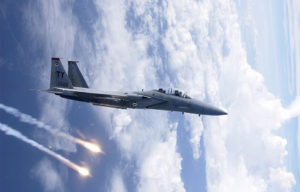
An ordinary mission with extraordinary results

US Air Force Capt. Tim “Rhino” Bennett and his weapons system officer Capt. Dan “Chewy” Bakke were on the lookout for Scud missiles near Al-Qa’im when they were discovered and came under attack from Iraqi helicopters.
In an article for Air Force Magazine, Bennett recalled:
“The mission was a Scud CAP [combat air patrol] in northwestern Iraq. During the Scud CAPs, we would look around with either the FLIR targeting pod or the radar to find the mobile Scuds. My wingman had twelve Mk. 82s, and I had four GBU-10s-2,000-pound LGBs-four AIM-9s, and two external fuel tanks. I was leading the flight.”
Enemy helicopters closing in

The operation began precisely at 1:00 a.m.
Steve Bennett and Robert Bakke flew their F-15s through dense cloud cover and powerful winds, remaining on their designated course despite the challenging conditions. During the mission, they received an urgent warning from a Boeing E-3 Sentry AWACS aircraft that five Iraqi helicopters were reportedly posing an immediate danger to a group of U.S. Special Forces personnel.
Using their onboard radar, Bennett and Bakke located the approaching Mil Mi-24 Hind attack helicopters, which were heavily armed and also capable of carrying troops. Recognizing the threat to the soldiers below, the pilots quickly moved to intercept the helicopters before they could reach and attack the Special Forces team.
Plan of attack

The two pilots targeted the lead Iraqi helicopter with a GBU-10 Paveway II laser-guided bomb, hoping to destroy it before it could leave the ground. A direct hit would have destroyed the aircraft. At the same time, even a successful takeoff could still have left it vulnerable to the blast, which had the potential to eliminate nearby enemy personnel as well.
Flying at approximately 2,500 feet and close to 700 miles per hour, Captain Bennett released the bomb from about four miles away. Moments later, the aircraft’s radar showed the helicopter climbing at roughly 100 knots. Bennett and his weapons systems officer, Captain Bakke, quickly understood the bomb would probably miss because its flight path was now set to pass beyond the fast-rising helicopter.
A near miss

As seconds went by with no sign that the bomb had exploded, Bennett told Bakke to keep the laser pointed on the Mi-24. He recalled saying, “There’s no chance the bomb will get him now,” but, remarkably, the helicopter turned toward them, allowing Bakke to secure the laser-guided bomb on the target.
“There was a big flash, and I could see pieces flying in different directions,” said Bennett. “It blew the helicopter to hell, damn near vaporized it.”
Worried about friendly fire

The AWACS came over the radio and told the pilot, “I understand you visually ID’d that as an Iraqi helo.” Bennett stated that, no, he hadn’t visually identified the target, but was able to tell it was an Iraqi Mi-24 using infrared technology. Both he and Bakke then grew tense, worried they’d accidentally hit a friendly helicopter. At the time, special operators were flying into Iraq in Sikorsky MH-53 Pave Lows, and Bennett wondered if they’d accidentally targeted one.
Thankfully, the AWACS confirmed that no friendly aircraft were in the area – the pair’s attack was successful.
Striker becomes the target

That wasn’t the end of Bennett’s unbelievable mission. After confirming the hit was an enemy helicopter, large flashes appeared all around. What he initially thought were surface-to-air missiles (SAMs) being fired from below were actually bombs being dropped from above.
“AWACS had sent another flight in and told them to drop bombs on a set of coordinates. Those coordinates happened to be us!” Bennett and Bakke immediately left the area, and with just 15 minutes remaining in their mission, managed to strike an enemy Scud missile before returning to base.
Tim Bennett left active duty following the Gulf War, but flew General Dynamics F-16 Fighting Falcons with the South Carolina Air National Guard until he retired in 2017, having reached the rank of lieutenant colonel.