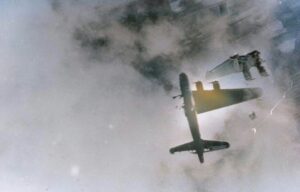
The tragic story behind the downing of the B-17 Flying Fortress ‘Wee Willie’

Photo Credit: United States Army Air Forces / National Museum of the USAF / Wikimedia Commons / Public Domain (Colorized by Palette.fm)

As the Second World War neared its end, Allied bombers continued launching intense strikes aimed at crippling what remained of Germany’s military and industrial capacity. One such mission involved Wee Willie, a B-17 Flying Fortress assigned to the 322nd Bomb Squadron. On April 8, 1945, while returning from a bombing run, the aircraft came under heavy German anti-aircraft fire.

A direct hit tore through Wee Willie’s fuselage, igniting a fierce blaze and sending the bomber spiraling out of control. Nearby crews could only watch in disbelief as the aircraft broke apart midair, descending in flames and smoke. In a somber turn, another airman managed to photograph the bomber’s final moments—images that would later stand among the most haunting visual records of the air war over Europe.

Today, those photographs remain a powerful testament to the bravery of bomber crews, who repeatedly flew into extreme danger knowing that any mission could be their last.

Boeing B-17G Flying Fortress Wee Willie

Nose art on the Boeing B-17G Flying Fortress 'Wee Willie'
Nose art on the Boeing B-17G Flying Fortress Wee Willie. (Photo Credit: Roger Freeman Collection / American Air Museum / Imperial War Museums CC BY-NC 3.0)

Wee Willie, a B-17G-15-B0 with the serial number 42-31333, was the 302nd B-17G Flying Fortress produced at Boeing Airplane Company’s Plant 2 in Seattle, Washington. Delivered to the US Army Air Forces in Cheyenne, Wyoming, in October 1943, the heavy bomber was later transported to RAF Bassingbourn in Cambridgeshire, United Kingdom.

Once in the UK, Wee Willie was assigned to the 322nd Bombardment Squadron (Heavy), part of the 91st Bombardment Group (Heavy), 1st Air Division, 8th Air Force.

At the time of its loss, the aircraft held the distinction of being the longest-serving aircraft within the 91st and was among the final planes to be lost to enemy action before the German surrender.

Preparing to bomb German railroad facilities

Crew of the Boeing B-17G Flying Fortress 'Wee Willie' standing near the aircraft
Combat crew of the Boeing B-17G Flying Fortress Wee Willie. (Photo Credit: Al_Skiff / Fold3 / American Air Museum / Imperial War Museums CC BY-NC 3.0)

In the early morning hours of April 8, 1945, the B-17G Flying Fortress Wee Willie took off from RAF Bassingbourn on what various accounts describe as its 128th or 129th combat mission. At the controls was pilot Robert E. Fuller, accompanied by Sgt. Le Moyne Miller, 2nd Lt. Woodrow A. Lien, Staff Sgt. James D. Houtchens, Tech. Sgt. Francis J. McCarthy, Staff Sgt. Ralf J. Leffelman, Staff Sgt. Wylie McNatt Jr., and Staff Sgt. William H. Cassiday.

Assigned to the 332nd Bombardment Squadron (Heavy), Wee Willie joined a formation of 72 B-17 bombers tasked with striking railway repair installations at the Stendal marshalling yards in Germany’s Saxony-Anhalt region. Dense clouds obscured the target, preventing the crews from carrying out a visual bombing run and forcing them to rely on H2S radar to navigate and aim their bombs. As the aircraft neared Stendal, German anti-aircraft batteries opened fire, filling the skies with intense flak. Such barrages remained among the most serious and constant dangers confronting Allied bomber crews operating far inside enemy territory.

Downing of the Boeing B-17G Flying Fortress Wee Willie

Boeing B-17G Flying Fortress 'Wee Willie' falling through the sky with one of its wings detached
Boeing B-17G Flying Fortress Wee Willie falling apart after a direct hit by German flak, April 1945. (Photo Credit: Roger Freeman Collection / American Air Museum / Imperial War Museums CC BY-NC 3.0)

During the mission, German anti-aircraft defenses inflicted light damage on 13 Allied bombers and serious damage on four more. Of the 73 aircraft involved in the operation, just two were lost completely, one of them being the B-17G Wee Willie. The bomber took a direct hit from an 88 mm flak shell between its No. 2 engine and bomb bay, causing the aircraft to plunge into a steep vertical dive.

One witness recalled: “The fuselage was on fire and when it had dropped approximately 5,000 feet [1,524 meters] the left wing fell off. It continued down and when the fuselage was about 3,000 feet [914.4 meters] from the ground it exploded and then exploded again when it hit the ground.”

Nine crewmen were aboard Wee Willie, but Lt. Fuller was the only survivor. According to reports, the initial explosion threw him from the cockpit, after which he managed to open his parachute and reach the ground safely. German forces captured him soon after he landed, although what happened to him afterward remains unknown.

The incident was recorded by an automatic strike camera installed aboard another B-17. The camera captured the mission from the moment the first bombs were released and continued filming until its supply of film was exhausted.

Loss of the Boeing B-17G Flying Fortress Times A-Wastin’

Crew of the Boeing B-17G Flying Fortress 'Times A-Wastin' standing near the aircraft
Combat crew of the Boeing B-17 Flying Fortress Times A-Wastin’. (Photo Credit: Roger Freeman Collection / American Air Museum / Imperial War Museums CC BY-NC 3.0)

During the air raid, the second bomber lost was a Boeing B-17G Flying Fortress named Times A-Wastin’. This aircraft, identified as B-17G-50-B0 with serial number 42-102504, was part of the 401st Bombardment Group (Heavy) and was flown by Lt. Peter Pastras.

Lt. Mike Fodroci, a navigator on another B-17, witnessed the moment Times A-Wastin’ was destroyed. He later recalled that German anti-aircraft fire hit the bomber in its bomb bay, likely killing Lt. Pastras instantly.

“The ship pulled up and veered to the right, climbing directly over our ship,” he recalled. “Captain Shelby put our ship into a dive so steep that I was thrown up against the astro hatch of the ceiling of the nose – seems I hung there for a brief second or two. I also observed that a bad fire was burning on the aircraft’s forward bomb bay area and that the co-pilot was trying to climb out of the small window with his backpack on. Somehow, we saw three chutes emerge from #504 as she spun toward the earth.”

Out of the crew aboard Times A-Wastin’, only two survived. Radio operator Bob A. Smith and flight engineer/top turret gunner Lyle Jones were captured by the Germans and, like Lt. Fuller, became prisoners of war.

Despite the loss of two bombers, the mission was deemed a success

Remnants of the Boeing B-17G Flying Fortress 'Wee Willie' shrouded in flames and smoke while it falls through the sky
Left wing of the Boeing B-17G Flying Fortress Wee Willie passing over the fuselage after it disconnected from the aircraft after a direct hit by German flak, April 1945. (Photo Credit: U.S. Air Force / Al_Skiff / This Day In Aviation / American Air Museum / Imperial War Museums CC BY-NC 3.0)

Even though the B-17Gs Wee Willie and Times A-Wastin’ were lost during the April 8, 1945 raid on Stendal, the mission achieved its objective. According to the 322nd Bombardment Squadron (Heavy), the bombs struck the railroad marshaling yards as planned, dealing a blow to German supply lines.

More from us: What Is the Real Story Behind WWII’s Famous Crying Child-Soldier Photograph?

The photos taken that day have preserved Wee Willie’s final moments in vivid detail. The haunting image of the bomber with its left wing sheared off has become one of the most powerful visual reminders of the risks faced by Allied airmen, capturing the intensity and sacrifice of the war’s final months.

Clare Fitzgerald

Clare Fitzgerald is a Writer and Editor with eight years of experience in the online content sphere. Graduating with a Bachelor of Arts from King’s University College at Western University, her portfolio includes coverage of digital media, current affairs, history and true crime.

Among her accomplishments are being the Founder of the true crime blog, Stories of the Unsolved, which garners between 400,000 and 500,000 views annually, and a contributor for John Lordan’s Seriously Mysterious podcast. Prior to its hiatus, she also served as the Head of Content for UK YouTube publication, TenEighty Magazine.

In her spare time, Clare likes to play Pokemon GO and re-watch Heartland over and over (and over) again. She’ll also rave about her three Maltese dogs whenever she gets the chance.

Writing Portfolio
Stories of the Unsolved

linkedin.com/in/clarefitz/