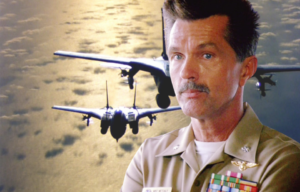
When Top Gun hit theaters in May 1986, it instantly captured audiences with adrenaline-fueled aerial dogfights and a vivid portrayal of life as a Navy aviator. The movie’s impact was so strong that U.S. Navy recruiters positioned themselves outside cinemas, connecting with enthusiastic viewers inspired to enlist after witnessing the high-flying action.
Much of the film’s authenticity came from the expertise of Rear Adm. Pete ‘Viper’ Pettigrew, a Vietnam War veteran and seasoned Navy pilot who acted as technical advisor. Pettigrew collaborated closely with both cast and crew, ensuring that dialogue, flight maneuvers, and combat tactics reflected real-world naval operations. His input lent the film a striking realism, helping it resonate with audiences and cement its place as a lasting cultural phenomenon.
Pete Pettigrew’s military career

Before serving as a technical advisor on the original Top Gun film, Pete Pettigrew had an outstanding military career. He began his service in the U.S. Naval Reserve and earned his wings as a naval aviator in 1966. After completing Fleet Replacement Training with Fighter Squadron 121 (VF-121), he was assigned to Fighter Squadron 151 (VF-151), where he flew McDonnell Douglas F-4 Phantom IIs during two intense 10-month combat tours in Vietnam aboard the USS Coral Sea (CV-43). During these deployments, he participated in missions that included engagements with Russian-built MiGs.
One of the major campaigns during this period was Operation Rolling Thunder (1965–1968), a prolonged bombing effort by the U.S. Navy and Air Force against North Vietnam. Widely viewed as ineffective due to political constraints and strategic limitations, the operation exposed significant gaps in pilot training and air combat effectiveness.
In response, the U.S. Navy reevaluated its approach to aerial warfare. This led to the creation of the Navy Fighter Weapons School—better known as TOPGUN. The program focused on teaching advanced dogfighting tactics and aerial maneuvering, drastically improving Navy aviators’ performance in combat. Pettigrew would later play a direct role in this effort and bring that same level of authenticity and expertise to Top Gun, helping ensure the film accurately reflected the skill and intensity of real-life air combat.
The US Navy’s TOPGUN school

After his deployments to Vietnam, Pete Pettigrew returned to San Diego. As a top Navy fighter pilot, he became an instructor at the Navy Fighter Weapons School, where he trained pilots in both air-to-air and air-to-ground combat from 1969 to 1972.
A sign at Naval Air Station (NAS) Miramar, where the training took place, described the program: “The four-week course started with a team of instructors covering U.S. and Soviet aircraft types, weapons systems, and fighter training tactics in a 50-foot-long metal trailer at [Naval Air Station] Miramar.”
Pete Pettigrew’s service, Post-TOPGUN school

Rear Adm. Pettigrew returned to the Vietnam War in 1972, serving aboard the USS Kitty Hawk (CV-63) with Carrier Air Wing II. During a May engagement, Pettigrew and his wingman confronted four North Vietnamese MiG-21s despite facing superior numbers, and each was credited with a confirmed aerial victory. Pettigrew is regarded as the only former TOPGUN instructor to achieve a confirmed air-to-air kill during the conflict. A number of pilots he had helped prepare also went on to claim victories in combat, providing further evidence of the impact of TOPGUN’s demanding training program.
A career in film soon came calling

From 1983 to 1986, Pettigrew worked with Paramount and even made a cameo in the movie. He appears in a scene as the date of Kelly McGillis‘ character, Charlotte “Charlie” Blackwood, while Tom Cruise‘s Lt. Pete “Maverick” Mitchell tries to impress her.
Tom Skerritt’s character, “Viper,” was also inspired by a real-life pilot, with parts of his role based on Pettigrew himself.
Pete Pettigrew’s legacy

When Pete Pettigrew ended his Navy career in 1998, he’d participated in over 375 combat missions in Southeast Asia, culminating in over 3,400 hours flying fighter aircraft. For his service, he was awarded a number of decorations: the Joint Superior Service Medal, two Navy Commendation Medals, 30 Air Medals, the Silver Star, the Distinguished Flying Cross, the Legion of Merit with Gold Star, two Meritorious Service Medals and the Defense Meritorious Service Medal.
More from us: The Five Greatest Fighter Aircraft Ever Flown By the US Military
The retired naval aviator soon threw himself into triathlons and was a master swimmer. In 2014, he and a team of other men set the record for the fastest swim over the Catalina Channel for those over 70 years old. During a speech to students at Menlo College the following year, he advised:
“The doors are open in your life. Don’t be afraid to go through them. No decision is still a decision, so don’t be afraid you will fail. The more you succeed, the easier it will be to walk through a doorstep. Watch for the doors.”
Rear Adm. Pete Pettigrew passed away on June 23rd, 2024.