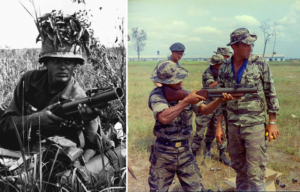
Project NIBLICK and the development of the M79 Grenade Launcher


The M79 grenade launcher was manufactured in the United States from 1961 to 1971, with a total of 350,000 units produced. It featured a simple, rugged design made up of five main components: the receiver group; the fore-end assembly (which connected the barrel to the receiver); the barrel group; the sight assembly; and the stock, which was made from either wood or fiberglass. The weapon measured 73.1 centimeters in length, with a 36.83-centimeter barrel.
When unloaded, the M79 weighed 2.7 kilograms, and 2.93 kilograms when loaded. It was operated much like a shotgun, with the grenadier loading a round near the center of the weapon. The M79 used two sights: a fixed front blade and a foldable rear sight adjustable for distances between 75 and 375 meters.
A standout feature of the M79 was its “high-low” propulsion system, which helped reduce recoil while increasing effective range. It performed best at a distance of around 350 meters, with a maximum reach of 400 meters.
The M79 was capable of firing a wide range of 40 mm rounds, including anti-personnel, buckshot, illumination, flechette, and smoke. One of the most effective was the M406 high-explosive (HE) grenade, which traveled at 75 meters per second. While it didn’t carry enough kinetic energy to kill outright, it could cause serious injuries, including penetrating the abdomen and creating internal bleeding.
Two rounds were specifically developed for the M79. The first was the flechette round, which fired 45 small, 10-grain steel flechettes. However, it was ultimately ineffective because the darts often struck targets sideways and bounced off. The second was the M576 buckshot round, which released 24-grain metal pellets. It was extremely lethal at close range but lost much of its stopping power at greater distances.
Use of the M79 grenade launcher in Vietnam

The U.S. Army first began using the M79 grenade launcher in 1961, and it quickly became an essential weapon in the Vietnam War. Soldiers valued it for being reliable, easy to operate, and packing serious firepower. The M79 was designed to bridge the gap between traditional hand grenades and mortars, earning the nickname “the platoon leader’s artillery.” In addition to its regular use, troops could also fire it indirectly by resting the buttstock on the ground and shooting it like a mortar.
The M79 was widely distributed among different combat units, including the 101st Airborne Division, the 1st Cavalry Division, the 173rd Airborne Brigade, and the 1st Infantry Division. It was issued to grenadiers in both Marine and Army rifle squads, where it proved especially effective in taking out Viet Cong bunkers.
The M79’s drawbacks

While favored by some US soldiers in Vietnam, the M79 grenade launcher had its drawbacks. It could only fire one round at a time, meaning its user needed to constantly reload the weapon. This made for a slow rate of fire, which was not conducive in a firefight. As such, the Navy developed the China Lake grenade launcher for its SEAL teams.
The second issue was the rounds needed to travel 40 meters to arm. While intended to be a safety feature, having such a distance between soldiers and the enemy wasn’t always possible. This meant most troops carried a secondary weapon, either a sidearm or an M16 rifle. However, it wasn’t always possible to carry the latter, given the M79’s large size.
Due to its drawbacks, the M79 was replaced by both the XM148 and the M203, which were underbarrel grenade launchers. While the XM148 was discontinued due to issues that plagued its design, the M203 was a success and became standardized. By the end of the war, it had replaced the M79. Although the launcher was still in service with National Guard and Reserve units.
Use of the M79 grenade launcher following Vietnam

Beyond its extensive use in Vietnam, the M79 grenade launcher has appeared in numerous other conflicts. These include civil wars in Cambodia, Laos, Bougainville, and Syria, as well as the Communist insurgency in Malaysia, the Falklands War, the Lebanese and Salvadoran conflicts, fighting in Burma, and clashes along the Thai-Cambodian border.
The M79 also saw service during the wars in Iraq and Afghanistan. During Operation Iraqi Freedom, it was used to engage suspected IEDs from a safer distance. Navy SEALs and Special Forces personnel also favored the weapon in some circumstances because it offered slightly greater range and accuracy than the M203.
In more recent years, the M79 has also been adapted for less-lethal roles, including crowd control. Police can use rounds such as the M1006 sponge grenade, M651 CS gas round, and M1029 crowd-dispersal round. Rather than being intended to stop an enemy combatant, these rounds are designed to help disperse crowds before a situation escalates into violence.