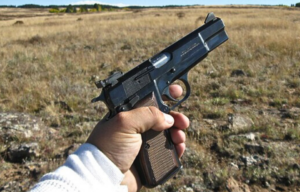
At the 2017 Armed Forces Skill at Arms (AFSAM) competition, the Canadian Armed Forces brought their top shooters equipped with 20 Browning Hi-Power semi-automatic pistols—firearms that had been in use since World War II. However, most of them didn’t hold up. Out of the 20 pistols, only five were still usable, while the other 15 malfunctioned during warm-ups and had to be taken out of service.
During the competition, the 10 Canadian shooters faced an average of 4.5 malfunctions each while firing a total of 2,810 rounds. Meanwhile, the 20 British shooters fired 5,620 rounds without a single malfunction.
Why does this matter? It shows just how outdated Canada’s military sidearm was. Despite the availability of newer, more reliable pistols, the Canadian Armed Forces were still using a handgun that was nearly a century old. It wasn’t until 2024—almost 90 years after the Hi-Power was introduced—that they finally replaced it with a more modern service pistol.
Development of the Browning Hi-Power

John Browning invented the Browning Hi-Power in 1911 for Fabrique Nationale, a company in Belgium. It was created in response to a request from the French military for a new pistol that could hold a 10-round magazine, remain compact, effectively hit a target at 50 meters, and be easy to take apart and reassemble.
The final version was officially introduced in 1935 and featured a detachable magazine that could hold 10, 13, 15, or 17 rounds, depending on the user’s needs. It could fire 9x19mm, 7.65x21mm Parabellum, and .40 S&W bullets. The pistol was compact and well-suited for combat situations.
One of history’s most reliable pistols

Over time, more than 50 militaries around the world adopted the Browning Hi-Power as their service pistol, and it was considered the most reliable of the era. It was so popular that it became one of the few to be equipped by both the Allied and Axis Powers during World War II and its associated conflicts, including the Winter and Continuation Wars.
Outside of the Second World War, the Hi-Power saw use with elite American units during the Vietnam War, as well as with the French during both the First Indochina War and the Algerian War. The pistol began to fall out of favor in the 1990s, as modern weapons began to show their capabilities, and production was ended in 2017. However, it was restarted in 2022, with upgrades made to the pistol.
Browning Hi-Power and the Canadian Armed Forces

Towards the conclusion of the Browning Hi-Power’s service with Canada, replacement parts were so scarce that military personnel had to cannibalize components from existing handguns to maintain operational sidearms. With modern warfare shifting toward tight urban environments where rifles were often awkward, Canadian soldiers had no choice but to rely on an increasingly obsolete and untrustworthy sidearm.
This decline turned the handgun into a running joke among Canadian personnel, who quipped that hurling the weapon at an opponent was preferable to pulling the trigger. Former Canadian Armed Forces competitive shooter Bob Kinch quipped that although he would choose the Browning over a pointed stick, he would still “look fondly” at the stick.
Similarly, the British military relied on Browning sidearms with World War II origins before pursuing a contemporary alternative, ultimately selecting the Glock 17 (Gen 4) following comparative testing. Although Canada faced identical issues with its decaying Hi-Power fleet, it took considerably more time to secure a replacement.
Why does the Canadian Armed Forces have so many units?

The Browning Hi-Powers equipped by the Canadian Armed Forces were manufactured by John Inglis and Company in Toronto, Ontario. They were intended to be sold to China to help combat the Japanese, but the latter surrendered before the pistols could be delivered, meaning Canada was left with a surplus of units.
There were so many, in fact, that, in the early 2000s, there were still unused Hi-Powers sitting in their original factory packaging.
Pursuing an alternative to the Browning Hi-Power

The Browning Hi-Power is showing its age in other ways, too. There’s no place to mount a flashlight on the original models, and the small sights are difficult to aim in low-light conditions. The pistols can’t be fired while wearing gloves or with the left hand, and the long hammer can cut open the shooter’s palm. They’re also pretty heavy, due to their all-metal construction.
The Canadian Armed Forces began looking into purchasing replacement service pistols in the mid-2010s, but the process became bogged down. To fill the gap left by the aging Hi-Powers, the military introduced the Army Interim Pistol Program to purchase around 7,000 pistols. The gun’s successor, the SIG Sauer P320 (designated the C22 in Canada), was chosen in 2022. Units began to be distributed in 2023, with it reported that the process was completed the following year.
More from us: Heckler & Koch G3: The Cold War-Era Battle Rifle That’s Stood the Test of Time
As for the Hi-Powers, it’s currently unknown how they’ll be destroyed. It’s been suggested they’ll be smelted, but this hasn’t been confirmed.