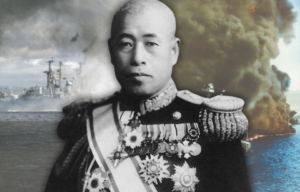
Photo Credit: 1. Photo12 / Universal Images Group / Getty Images 2. MPI / Getty Images 3. Unknown Author / National Diet Library / Wikimedia Commons / Public Domain
Isoroku Yamamoto, one of Japan’s foremost naval strategists, viewed the prospect of war with the United States far differently than many of his counterparts within the Imperial Japanese Navy. Having spent considerable time in America—including serving as a naval attaché in Washington, D.C.—he gained firsthand insight into the nation’s enormous industrial power, technological capabilities, and ability to rapidly mobilize for war. Those experiences made him deeply cautious about provoking the United States, concerns he repeatedly voiced despite being largely ignored by many within Japan’s leadership.
By late 1941, however, Yamamoto found himself with little strategic flexibility. He was assigned to organize and oversee the Attack on Pearl Harbor, believing that Japan’s only chance lay in delivering a devastating blow to the U.S. Pacific Fleet at the outset of the conflict. Drawing on his understanding of American strength, he hoped such an attack might provide Japan with a temporary strategic advantage and enough time to consolidate its position in the Pacific. Even so, Yamamoto remained aware of the enormous gamble involved, recognizing that war against a nation with the United States’ industrial and military capacity could ultimately prove impossible for Japan to sustain.
Born in 1884 as Isoroku Takano, the future admiral rose to become one of the Imperial Japanese Navy’s most influential officers. His father, a relatively low-ranking samurai, was 56 at the time of his birth. In 1916, he was adopted by the distinguished Yamamoto family, which had no male successor to carry on its name. Such arrangements were customary in Japan, enabling families to maintain their surnames and ancestral lines. As a result, Takano adopted the Yamamoto surname and became part of a higher-status samurai household.
After graduating from the Imperial Japanese Naval Academy in 1904, Yamamoto entered naval service and soon participated in the Russo-Japanese War. During the Battle of Tsushima, he suffered wounds that cost him two fingers on his left hand: his index and middle fingers. His contributions during the war earned him recognition and helped establish the foundation for his subsequent rise through the Imperial Japanese Navy.
By 1916, Yamamoto had attained the rank of lieutenant commander, advancing to commander three years later in 1919. His steady progression through the ranks strengthened his position and influence among Japan’s senior naval leadership.
Experience in the US, rivalry with the Japanese Army
Yamamoto Isoroku, Admiral and Commander-in-chief of the Japanese Fleet, receives a medal, 1940. (Photo Credit: Bettmann / Getty Images)
Yamamoto spent a fair amount of time in the US during the 1920s and ’30s. He was a student at Harvard University from 1919-21. He also had two postings as a naval attaché in America, where he learned to speak fluent English. Yamamoto created controversy in 1937 when he apologized to the US for Japan’s 1937 bombing of the gunboat USS Panay.
The Imperial Japanese Army was significantly more aggressive and pro-war than its Navy, and was angered by Yamamoto’s opposition to a pact with Germany and Italy. Following his apology to the US, he received death threats, to which he said:
“To die for Emperor and Nation is the highest hope of a military man. After a brave, hard fight, the blossoms are scattered on the fighting field. But if a person wants to take a life instead, still the fighting man will go to eternity for Emperor and country. One man’s life or death is a matter of no importance. All that matters is the Empire.”
Attack on Pearl Harbor
USS West Virginia (BB-48) and Tennessee (BB-43) on fire during the Japanese attack on Pearl Harbor. (Photo Credit: US Navy / Interim Archives / Getty Images)
Propelled by keen analytical intellect, firm leadership, and an ahead-of-his-time grasp of maritime strategy, Isoroku Yamamoto steadily climbed the hierarchy of the Imperial Japanese Navy. His promotion to admiral arrived in November 1940, securing him high standing among naval peers and the confidence of parts of the Imperial court, despite ongoing friction between his forward-thinking concepts and the traditionalist mindset of conservative military leaders.
Behind closed doors, Yamamoto harbored grave doubts regarding an armed struggle against the United States. Recognizing that the American manufacturing powerhouse far outmatched Japan’s limited industrial resources, he foresaw that an extended confrontation would work decisively against his nation. These concerns directly influenced his orchestration of the attack on Pearl Harbor; assuming hostilities were inevitable, he reasoned that Japan’s sole viable strategy was to execute a rapid, devastating blow against the U.S. Pacific Fleet to postpone an American counterattack.
Tactically, the initial strike proved remarkably effective, sinking or severely impairing several American battleships while wrecking or disabling close to two hundred airplanes in just a few hours. From a strategic perspective, however, the offensive severely backfired. Rather than subduing the adversary, it unified the American populace and mobilized the country’s vast military and industrial potential. Ultimately, Yamamoto’s initial misgivings were fully borne out, as the prolonged war he had advised against played a decisive role in Japan’s final downfall.
Battle of Midway and Yamamoto’s death
Artist’s impression of the Battle of Midway, 1942. (Photo Credit: Hulton Archive / Getty Images)
Despite initial Japanese successes after Pearl Harbor, Yamamoto advocated for continued attacks on the US Fleet. The Battle of Midway in June 1942 was intended to maintain Japanese offensive momentum. However, before the operation, US forces were able to break the Japanese Naval Code. This intelligence allowed Admiral Chester Nimitz to prepare effectively, resulting in a decisive US victory that shifted the course of the war.
Following setbacks and defeats at Guadalcanal and Midway, Yamamoto embarked on a morale-building tour for his forces. US intelligence intercepted and decrypted details of his itinerary, enabling American pilots to shoot down his plane on April 18, 1943. Posthumously, Yamamoto was honored with the title of Marshal Admiral and awarded the Order of the Chrysanthemum by Japan. Additionally, he received Germany’s Knight’s Cross of the Iron Cross.
Yamamoto’s legacy
Isoroku Yamamoto. (Photo Credit: National Diet Library / Wikimedia Commons / Public Domain)
Yamamoto has been featured in a number of films about Pearl Harbor and World War II. Moviegoers may remember him for the Tora! Tora! Tora! (1970) line that he may or may not have uttered: “I fear that all we have done is to awaken a sleeping giant and fill him with a terrible resolve.” The line was also referenced in 2001’s Pearl Harbor.
Historians, however, are not sure he ever actually made this observation.
Yamamoto was also portrayed by legendary actor Toshiro Mifune in three separate films: Rengo Kantai Ichokan Yamamoto Isoroku (1968), Gekido no showashi ‘Gunbatsu’ (1970), and Midway (1976).