What is a grenade?

Contemporary hand grenades comprise an internal explosive charge, a detonator and an internal striker responsible for initiating the explosion. These components are secured by a lever and pin safety device. While there are diverse grenade types designed for specific purposes, the fragmentation grenade stands out as the most prevalent.
The roots of grenades can be traced back to the Byzantine Empire, where small ceramic canisters resembling pomegranates were utilized. These containers were filled with “Greek fire” and employed to set ships ablaze in naval battles. Concurrently, during the Song Dynasty (960-1279 AD) in China, ceramic vessels filled with gunpowder and fuses contributed to the historical evolution of grenades.
The advent of the modern grenade took place in Britain in 1906, although formal adoption by the British Army didn’t occur until ’13. The outbreak of World War I propelled advancements in hand grenade technology throughout Europe, leading to the creation of novel models like the Mills bomb, acknowledged as the inaugural modern fragmentation grenade.
Today, the weapon varies in form and purpose, from fragmentation grenades to high explosive ones, anti-tank and stun grenades (also known as flashbangs).
Movie error #1: Pulling the pin with your teeth


War movies frequently depict characters hurling grenades, followed by a dramatic explosion and a slow-motion dash to safety—classic Hollywood flair. Yet, this representation strays far from the truth. In reality, grenades aren’t designed to produce towering fireballs; their main purpose is to scatter lethal fragments across a wide radius.
Typically, the average casualty radius of a standard hand grenade falls between five and 20 meters. Within a 10-meter radius, it can be deadly, and injuries remain likely even out to 20 meters. Despite this lethality, grenades lack the cinematic punch seen on screen—they don’t generate the fiery blasts that movies so often exaggerate.
Movie error #3: The effects of shrapnel

The M67 fragmentation grenade is still among the most commonly used grenades today. Intended primarily as a defensive weapon, it is designed to send metal fragments outward when it detonates. Improvised weapons can also produce fragmentation, although devices such as Molotov cocktails rely mainly on fire rather than fragmentation for their destructive effect.
Movies, television, and video games often portray the blast itself as the greatest threat from a fragmentation grenade, downplaying the danger posed by flying fragments. In reality, fragmentation is generally the primary lethal mechanism of the M67, while the blast pressure can also cause injury, particularly at close range.
Movie error #4: Throwing the grenade like a baseball

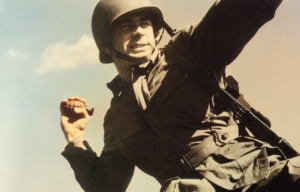
When soldiers throw a grenade in movies, they usually throw it lightly over the shoulder like a baseball. In reality, grenades are much heavier than the average baseball, weighing around 400 grams (depending on the model), while a baseball only weighs 141 grams.
It takes time and practice for soldiers to properly learn how to throw a grenade with enough force to avoid falling victim to the 20-meter-wide casualty radius.
Movie error #5: Projectile grenades are not missiles

Grenade launchers and rocket launchers might look similar on screen, but in real combat, they serve very different purposes.
Grenade launchers—sometimes called projectile grenade systems—first saw action in World War I with crude catapult-style devices. Today’s models are far more advanced, offering better range, accuracy, and safety. They fire explosive rounds using external propellant (like a cartridge), making them relatively light and easy to operate. This makes them ideal for close-to-medium-range targets, especially in infantry combat.
Rocket launchers (like RPGs), on the other hand, are much larger and use self-propelled warheads designed to punch through armor or fortifications from a distance. While more powerful, they’re also heavier, slower to reload, and pose greater risks if mishandled.
Despite what Hollywood often shows, these two weapons aren’t interchangeable. Grenade launchers are about rapid, mobile firepower. Rocket launchers are about long-range impact and serious destruction. Both have a place on the battlefield—but for very different reasons.
Movie error #6: You can’t actually throw grenades back

One movie trope that likely bothers many soldiers and military enthusiasts is when characters throw back unpinned grenades – especially when they’ve been sitting on the ground for more than a few seconds. While throwing the weapon back can be accomplished in some circumstances, it’s incredibly difficult (and inadvisable), unless one has a death wish.
More from us: The Worst Position to Hold in WWII Was as a Ball Turret Gunner
There’s only a few seconds of space between the pin being pulled and the grenade going off, and thus the only way a soldier could even successfully lob the weapon back is if they were to catch it straight out of the air. This hardly ever happens. The most likely scenario is it’ll roll and bounce on the ground, not giving someone enough time to run up to it, grab it and throw it back before detonation.