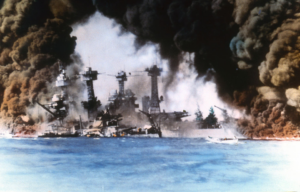
Much has been said about the Japanese attack on Pearl Harbor, but how much of it is true, and how much has changed over time? When the U.S. entered World War II, fear and panic spread, making it easy for false information to take hold. This led to several myths about the surprise attack—but what really happened?
Here are four common myths and the facts that set the record straight.
Pearl Harbor was the only target

A widespread misconception is that Pearl Harbor was the only target of the Japanese on December 7, 1941. Although it is the most famous, it was just one of six targets. On the same day, the Japanese also launched attacks on Guam, Wake Island, Midway, Thailand, and Malaya (due to time zone differences, some of these are recorded as happening on December 8).
Pearl Harbor was only a single part of a larger Japanese campaign to dominate the Pacific. This strategy was largely successful over the following year, with only the naval station at Pearl Harbor and Midway managing to resist Japanese control during the Second World War.
The continued belief in this myth can be attributed to the fact that the attack on Pearl Harbor was the most devastating of the assaults. It resulted in the greatest number of American casualties that day and brought the harsh reality of war directly to the American public.
Japanese-Americans were the only ones detained after the attack

The internment of Japanese Americans is well known and leads many to believe they were the only citizens detained after Pearl Harbor. This myth grew to its standing today because of the harsher treatment Japanese Americans faced.
Following the attack, more than 3,000 individuals were arrested by the Federal Bureau of Investigation (FBI), the G-2 unit within the US Army and the Office of Naval Intelligence for subversive activity. This included Japanese-Americans, along with people of Italian and German descent.
Over the course of World War II, around 120,000 Japanese-American citizens were sent to internment camps, and approximately 11,000 German-Americans were interned as well. An estimated 600,000 people of Italian descent were kept under restrictions.
A quick and decisive response by the United States

The idea that the US government and military responded to the devastating attack quickly and decisively is a popular one, but it’s a myth. In the months following what took place, the country suffered multiple defeats in the Pacific region.
This myth may have started when a rumor spread throughout the country on December 8, 1941, that the US Navy was in pursuit of the Japanese fleet. This is false, with Gen. Douglas MacArthur actually pleading for more naval assistance. In reality, a telegram was sent to President Franklin D. Roosevelt, asking for assistance and submarines to target Japanese vessels. This went unanswered and is believed to have led to the fall of the Philippines.
The first major offensive by the US occurred in February 1942, when the Pacific Fleet launched attacks on the Marshall and Gilbert Islands. Before these raids, the last successful engagement had occurred prior to Pearl Harbor.
Pearl Harbor convinced the United States to join World War II

The attack on Pearl Harbor is frequently portrayed as the moment the United States entered World War II in full and went to war against every Axis nation. However, the country’s formal involvement in the conflict developed in separate steps.
Before Pearl Harbor, the United States had generally avoided becoming directly involved in overseas conflicts, including the ongoing war in Europe. After Japan attacked, Franklin D. Roosevelt presented a declaration against Japan to the US Congress, and the measure passed by an overwhelming margin. The decision formally put the United States at war with Japan in the Pacific, but Germany and Italy were not yet officially at war with the United States.
More from us: Tuskegee Airmen: The African-American Pilots Who Broke Barriers in World War II
That changed on December 11, 1941, when Germany and Italy declared war on the United States, formally bringing America into the conflict against those two Axis nations as well.