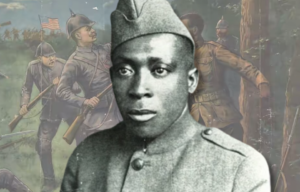
Henry Johnson enlisted in the New York National Guard

Assigned to the French Army’s 161st Division

From the get-go, the eager regiment – at that point renamed the 369th Infantry Regiment and later becoming known as the “Harlem Hellfighters” – was relegated to menial tasks, such as cleaning and moving goods. They were temporarily assigned to the 161st Division of the French Army by Gen. John J. Pershing. It’s believed the reason was that Pershing wanted to give African-American soldiers a chance to advance in leadership, which they couldn’t do in the segregated US Army.
The French Army had no such issue and gladly accepted the men as reinforcements, kitting them out with equipment. Johnson and his regiment were deployed to Outpost 20, near the Argonne Forest.
A nighttime raid was Henry Johnson’s chance to be a hero

On the evening of May 14, 1918, Henry Johnson could not have known that the events ahead would come to define his legacy. He and fellow soldier Needham Roberts were assigned to guard a position along the edge of a forest, and their watch was supposed to conclude at midnight.
When two soldiers arrived to relieve them, Johnson determined that the replacements lacked enough experience to manage the position on their own. Rather than leave at the end of his shift, he remained behind to support them. Roberts went back to the trench to rest while Johnson continued standing watch. Before long, Johnson heard unsettling noises from the woods, including movement among the trees and the unmistakable sound of wire cutters clipping through the barbed wire in the darkness.
German troops attack

Once the grenades were expended, Johnson seized his rifle and continued defending against the attackers, enduring further wounds to his side, head, and hand. When the rifle jammed, he wielded it as a club, striking at anyone who came near.
During the chaotic fight, a severe blow to his head left Johnson momentarily stunned. He quickly recovered, drawing his 14-inch bolo knife and striking with lethal precision, killing one German instantly. Noticing the enemy trying to carry off the wounded Roberts, Johnson surged forward, injuring another soldier and forcing the remaining attackers to retreat in fear.
Johnson saved him and Roberts’ lives

After an hour of fierce fighting, reinforcements showed up, forcing the Germans to pull back. Johnson’s extraordinary courage guaranteed that both he and Roberts made it through, with quick medical care provided for their injuries.
As the first light of dawn lit up the scene, the aftermath of the clash became visible: their wounds, their gear, and four fallen German soldiers. Johnson is said to have wounded another 25 to 30. His heroic stand quickly became the talk of the town, earning him a promotion to sergeant and the moniker “the Black Death.”
Awarded the Medal of Honor nearly a century later

For his efforts, the French awarded Henry Johnson the Croix de Guerre, one of their highest awards, before sending him back to the US. At the end of the First World War, the Harlem Hellfighters participated in a victory parade, with Johnson upfront. Still, they were not allowed to parade alongside the White troops.
After such an ordeal, many soldiers would return home to a hero’s welcome, which Johnson did, to an extent, but it was a bittersweet achievement. Many publications quickly glossed over his race, or avoided mentioning it at all. He gave his all and returned to a country celebrating his efforts while still regarding him as an inferior citizen.
More from us: John Simpson Kirkpatrick: The ‘Man with the Donkey’ in Galipoli
The final years of Johnson’s life mirrored the first, slipping into obscurity after the war, while receiving disability payments from the US government. It remains unclear how much his injuries affected his later life and job opportunities. He passed away on July 1, 1929 of myocarditis. The full extent of his actions wasn’t appreciated until he was posthumously awarded the Purple Heart in 1996 and the Medal of Honor by then-US President Barack Obama in 2015.