Operation Downfall

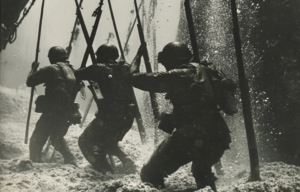
Operation Downfall was the U.S. military’s detailed plan to invade and defeat Japan, and it was set to be the largest amphibious invasion in history—surpassing even D-Day. The plan had two main parts: Operation Olympic and Operation Coronet.
Olympic was scheduled to launch in November 1945, targeting the southern island of Kyūshū. Once captured, Kyūshū would be used as a base to support Coronet, the second and even larger phase. Coronet was planned for March 1946 and aimed to invade the Tokyo Plain.
The invasion never happened. Japan surrendered after the atomic bombings of Hiroshima and Nagasaki, along with the Soviet Union’s declaration of war. As a result, the U.S. called off Operation Downfall, avoiding what likely would have been a devastating loss of life on both sides.
Training kamikaze frogmen

As an Allied invasion of the Japanese home islands appeared increasingly likely, Japan pursued an extreme coastal defense tactic called the Fukuryu, meaning “crouching dragon.” The plan centered on trained divers who would hide beneath the water and attack enemy ships as they approached the shoreline.
Captain Kiichi Shintani of the Anti-Submarine School at Yokosuka Naval Base first proposed the idea in 1944. As dwindling personnel and equipment made conventional defenses more difficult to sustain, Shintani drew on lessons from earlier battles that had inflicted severe losses, including the fighting on Peleliu.
Fukuryu formations were assigned to important sections of Japan’s coast, where divers were supposed to wait underwater and out of sight for an invasion force. Their planned missions involved operating under cover of darkness and using explosive charges against approaching vessels. By moving below the surface and remaining concealed, the divers were intended to evade detection and pose a serious threat to enemy forces nearing the coast.
Fukuryu attacks

In Japan’s final preparations to repel a possible Allied invasion, specially trained kamikaze frogmen were assigned to carry out covert underwater attacks against enemy ships. Using basic diving equipment, they were armed with 16-foot bamboo spears tipped with Type 5 contact mines, each carrying roughly 33 pounds of explosives designed to detonate on contact.
Their launch areas were often supplied with additional explosive charges to increase the potential damage of these attacks. The missions were intended as one-way operations from the outset. The frogmen understood that detonation would kill them instantly, making survival impossible. Hidden beneath the water for extended periods—motionless and waiting—they remained fully aware that success meant sacrificing their own lives in the process.
Training the kamikaze frogmen

Extensive preparations were made to train 6,000 kamikaze frogmen, each requiring specialized equipment. They were to wear full diving suits—jacket, pants, shoes, and helmet—and carry oxygen supplies and liquid food to survive about 10 hours underwater. To stay submerged at depths of 16 to 23 feet, each man also carried 20 pounds of lead to fight buoyancy.
Beyond equipping the divers, Japan planned to build hidden underwater shelters where they could lie in wait for enemy ships. One idea was to build large concrete structures on land and later sink them into place, but this plan was never carried out. Another idea involved steel underwater foxholes, but it was quickly scrapped due to the risk of disturbing nearby explosives.
Even with all the detailed planning, Japan’s kamikaze frogmen were never actually used in combat.
A failed initiative

The 71st Arashi unit trained at Yokosuka, while the 81st Arashi began their instruction at Kure. A third unit was planned for Sasebo, but progress stalled. By the time Japan surrendered, only two battalions—both from the 71st—had completed their training, totaling roughly 1,200 of the proposed 6,000 men.
Training delays weren’t the only problem. Equipment production lagged as well. At surrender, just 1,000 diving suits had been manufactured, and none of the actual explosive mines had been built—only practice versions existed.
Although the Fukuryu divers were never deployed in combat, the training process proved deadly. Many recruits lost their lives due to faulty breathing systems. The crude gear required divers to inhale through their nose and exhale through their mouth into a canister meant to recycle the air. A simple mistake in this process caused them to breathe in caustic lye and lose consciousness underwater. If seawater seeped into the apparatus, it created a chemical reaction that severely burned the lungs when inhaled.
Some divers also drowned after becoming entangled in underwater vegetation and being unable to escape. In the end, no enemy forces were harmed by Fukuryu operations, but so many trainees died during preparation that, reportedly, “they couldn’t keep up with cremation.”