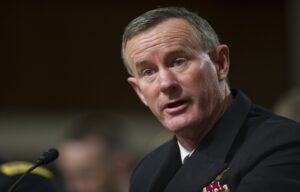

William McRaven’s path to a military career appeared to be set from the start. Born in Pinehurst, North Carolina, he spent his early years there while his father, Claude, was stationed at Pope Army Airfield. A World War II-era Spitfire pilot and former NFL player, his father likely had a significant influence on McRaven’s decision to pursue a military career.
While in elementary school, McRaven moved to Texas, where he became heavily involved in track and field. He later joined the Navy ROTC program and, in 1977, graduated from college with a Bachelor’s Degree in journalism.
McRaven’s early military career

After completing his college education, William McRaven began his military career by entering the Navy’s demanding SEAL training program. He completed the grueling course and, following a probationary period, earned his place among the elite United States Navy SEALs.
In the early 1980s, McRaven was assigned to Dam Neck, Virginia, where he served under Richard Marcinko, the first commander of SEAL Team 6. Their leadership styles quickly clashed, ultimately leading to McRaven’s removal from the unit. Marcinko later reflected on their differences, noting that while McRaven was highly intelligent, their approaches to special operations leadership were fundamentally at odds.
Despite this early setback, McRaven’s career continued to advance. He went on to command a task unit during the Persian Gulf War and later earned a Master of Arts from the Naval Postgraduate School in 1993, further strengthening his expertise in strategy and leadership.
Broken in half

While McRaven was well on his way to a storied military career, it almost didn’t happen. He told NPR in 2019 about a ’01 training exercise where he was nearly killed after being hit in the air by another parachutist.
“I kind of tumble through the parachute. But I’m stunned,” he said. “I’m not exactly sure what’s happened. I don’t know whether I’ve been knocked unconscious. I don’t know whether I’ve been dazed. And now I’m tumbling out of control towards the ground.”
He continued, “Because I was tumbling, the pilot chute came out and wrapped around one leg, and then another part of the parachute called the riser came out and wrapped around my other leg. So now I am tangled up in my parachute, falling towards the ground. The good news is, as I fell a couple hundred feet or a thousand feet or so, the parachute finally opened. The bad news is, when a parachute opens, it blossoms.”
The accident resulted in a broken pelvis for McRaven. A few months later, 9/11 happened. At this time, he was still recovering from his injuries.
Operation Neptune Spear

In 2011, William McRaven was a US Navy vice admiral serving as commander of the Pentagon’s Joint Special Operations Command when CIA Director Leon Panetta briefed him on a critical development. Panetta informed McRaven that the CIA had found Osama bin Laden and placed him in charge of overseeing the operation to kill him. Drawing on his extensive background in planning and executing sensitive, high-risk missions, McRaven was given full authority over the operation.
The mission succeeded when SEAL Team 6 carried out the raid that killed bin Laden on May 2, 2011. McRaven received widespread recognition for his leadership and strategic abilities and was subsequently named a finalist for Time magazine’s Person of the Year.
McRaven formally retired in 2014
