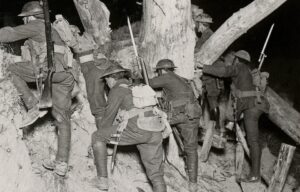
The English language is constantly evolving, with new words being introduced all the time. This has been happening for centuries—English has always borrowed words and phrases from different periods in history. Some slang from the trenches of World War I still influences how we speak today, although not all of those expressions are still popular.
Napoo

An expression that never became common in modern English is “napoo.”
This slang term from World War I has its origins in the French language. It derives from the French phrase “il n’y a plus,” meaning “there is no more.” English-speaking soldiers serving alongside the French in the trenches adapted the phrase for easier pronunciation, resulting in “napoo.”
The term was frequently used to refer to something that was finished, destroyed, or dead.
Blimp

Although the word “blimp” is now widely used to describe certain airships, the term first appeared during World War I, and its true beginnings remain a bit of a mystery.
One popular explanation links the name to an airship classification method. According to this theory, flexible, non-rigid airships that could change shape as they expanded or contracted were described as “limp airships.” Within the classification system, these craft were designated as B: Limp, leading some to believe that the word “blimp” evolved from combining the category letter with the descriptive label.
A second theory, often considered more believable, argues that the term is onomatopoeic and was inspired by the sound an airship made when fully inflated.
Skive

The word “skive” likely comes from an English version of a French word. Its exact origins are unclear, but it first appeared as military slang during World War I. Experts think it may have come from the French word “esquiver,” which means “to avoid” or “to escape.” People used “skive” to talk about avoiding work or responsibilities.
If this link to the French word is correct, “skive” would be one of the most interesting slang words borrowed from French into English.
Blighty

During World War I, British troops adopted a term that came to carry special significance: “Blighty.” Today, it is widely recognized as a nickname for Great Britain, but the word has roots in Urdu. It developed from “Vilayat” and “vilayati,” terms meaning “settled land” and “foreign,” respectively.
By the 1800s, a regional form of the Urdu word, “bilayati,” had entered British military language. During the war, however, Blighty came to mean more than Britain itself. The term was also associated with a specific kind of wound—one severe enough to send a soldier home, but not likely to prove fatal. For troops at the front, suffering a “Blighty wound” therefore offered the prospect of a welcome journey back to Blighty.
In a flap

If you’re feeling anxious about something, you might describe yourself as being “in a flap.” This expression originated in 1916, during the height of World War I, and was commonly used by naval personnel. It likely draws inspiration from the restless flapping behavior of birds.
The phrase also paved the way for the term “unflappable,” which appeared much later in the 1950s and means being “unfazed.”
No bon

A slang expression that originated in the trenches of World War I but didn’t last is “no bon.” This term, a combination of English and French, was commonly employed by British soldiers, where “no” is English and “bon” is French. It translates to “no good,” as “bon” means “good” in French.
Over the top

This slang term from World War I has made a comeback in recent years, though it mostly faded away after the war.
Today, people use it to describe something excessive or unnecessary, which is very different from its original meaning. Back during the war, it referred to an attack from the trenches, where soldiers had to climb over sandbags and charge into battle.
It was also used to describe the start of a risky mission with little chance of survival.