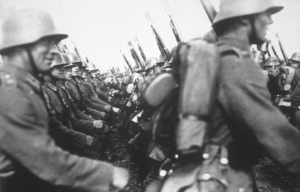
In the 2001 HBO miniseries Band of Brothers, Tech. Sgt. Donald Malarkey, played by Scott Grimes, talks to a German prisoner of war and asks where he’s from. The prisoner responds, “Eugene, Oregon,” and explains that his family believed they had a duty to go back to Germany and fight for their homeland. This moment brings up an intriguing question: how many German Americans left the U.S. to fight for Germany during World War II?
The exact numbers are unknown

The issue with this question is that there are no concrete numbers available to provide an easy answer. Prior to and during the Second World War, various programs and initiatives were introduced to encourage ethnic Germans to return to Germany. However, the extent to which these efforts succeeded in recruiting soldiers remains unclear.
In The German Order of Battle: Waffen SS and Other Units In World War II by George Nafziger, it is noted that five German Americans served in the Waffen-SS during World War II. These individuals were identified as “US Volksdeutsche,” meaning they were of German heritage. Nafziger includes them as a footnote within broader data on the nationalities of SS personnel.
One such program aimed at ethnic Germans was the Rüeckwanderer, which encouraged individuals to visit their local German consulate and pledge allegiance to Germany. Participants were required to declare their intent to return to the country, at which point they were given access to a special currency that could be used within Germany.
The number of individuals who returned under this program before it ended is unknown, and it is equally unclear how many ultimately fought for Germany.
German American Bund

The German American Bund served as an American ally to the National Socialist German Workers’ Party. Although its message may have inspired some German Americans to travel to Germany to fight in WWII, the organization overall did not achieve its intended goals.
Modeled after Germany’s government, the German American Bund ran multiple training camps throughout the US. The organization held rallies to spread Germany’s message, and, like the Führer, its leaders condemned Communism and expressed anti-Semitic views.
The Bund’s first leader was WWI veteran Fritz Julius Kuhn, a German-American who was later imprisoned on embezzlement charges. This event caused disarray within the organization, and subsequent leaders struggled to match Kuhn’s influence.
The German American Bund was closely monitored by the US government, largely because of its draft evasion campaign. This scrutiny led to additional leaders facing prosecution—one even fled to Mexico to escape the authorities.
The organization’s records lack any propaganda explicitly urging German Americans to return to Germany. If there were calls to fight for the fatherland, they did not originate from within the US.
Many important documents didn’t survive the war

Martin James Monti deserted the USAAF and the Waffen-SS

There were a few cases where non-German Americans joined the German military. The most famous was Martin James Monti, a second lieutenant within the US Army Air Forces (USAAF).
Monti grew up listening to radio broadcasts by Roman Catholic priest Charles Coughlin, who spoke highly of Germany and Italy’s fascist governments. He was commissioned as a flight officer into the USAAF in early 1944, and while stationed in Italy, he stole a Lockheed P-5E Lightning. He flew to Milan, where he surrendered to the Germans.
The aircraft was tested by the Luftwaffe‘s Zirkus Rosarius unit, and Monti was given a spot in the SS‘ propaganda unit in Berlin. While on the radio, he spoke under an alias. Outside of these duties, he also helped create a propaganda leaflet that was handed out to Allied POWs.
In 1945, aware of Germany’s imminent defeat, Monti fled Berlin. At first, the Allies believed him to be a German POW, but under interrogation he revealed he’d deserted the USAAF. He claimed to have stolen the P-5E because he was “bored,” adding he did so to “personally fight the Germans himself.” He said he’d been shot down during his flight and wound up joining a partisan group.
Surprisingly, the Americans believed Monti’s story and only court-martialed him on charges of desertion and theft. While he was initially sentenced to 15 years in prison, this was later suspended by US President Harry S. Truman, on the condition he re-enlist with the USAAF, later the US Air Force. He did just that, receiving an honorable discharge in January 1948.
Immediately following his discharge, the FBI arrested Monti for his propaganda work in Germany. He was subsequently indicted on 21 acts of treason, to which he pleaded guilty and was sentenced to 25 years in prison. He served his sentence in Kansas, and at one point tried to withdraw his plea, claiming he’d been pressured to admit to the charges against him by his attorney.
Monti’s appeal was ultimately rejected, and he remained in prison until he was paroled in 1960.
Donald Malarkey said the encounter in Band of Brothers did occur

The WWII-era German-American POW depicted in Band of Brothers is believed to have been based on a real person. The real-life Donald Malarkey later recalled the incident did occur, although there are no after-action reports to corroborate his story.
Malarkey served as a non-commissioned officer with Easy Company, 2nd Battalion, 506th Parachute Infantry Regiment, 101st Airborne Division. He participated in several engagements during WWII, including Mission Albany, Operation Market Garden, and the Battle of Bastogne.
More from us: Before He Was Obi-Wan Kenobi, Alec Guinness Was Part of the Allied Invasion of Sicily
The truth is we’ll likely never actually know how many German Americans went to fight for Germany during WWII. We’ll also never know how common such a decision was among the 1.2 million individuals of German descent who lived in the US at the start of the conflict.