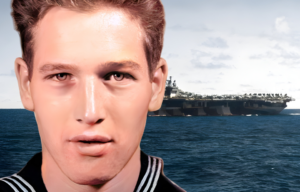
Before becoming a Hollywood legend, Paul Newman served in the U.S. Navy during World War II, spending time aboard aircraft carriers in the Pacific Theater. Following his military service, he emerged as a defining figure in Vintage Hollywood, earning widespread recognition for his memorable performances, charitable endeavors, and enthusiasm for auto racing. Newman’s remarkable career solidified his place among the 20th century’s most influential entertainers, leaving an enduring impact that reached well beyond the silver screen.
Paul Newman’s early life

Narrowly missing certain death in the Pacific

Joining the US Navy just four days before his 18th birthday, Paul Newman initially joined the V-12 program at Yale University. However, he was removed when officials noticed his colorblindness and difficulty with mathematics. He was sent to boot camp, where he trained to be both a rear gunner and radioman. He wasn’t particularly adept at the former, with his friends having to embellish his success to their trainers, so he could pass.
After qualifying to serve aboard torpedo bombers – in particular, the Grumman TBF Avenger – Newman was sent to Naval Air Station Barbers Point, Hawaii, where he was assigned to training squadrons VT-98, VT-99 and VT-100, focusing on training aircrews and pilots in the likes of carrier landings.
After serving aboard an unspecified aircraft carrier as a turret gunner, Newman was assigned to the USS Bunker Hill (CV-17). This was just before the Battle of Okinawa, and he narrowly escaped certain death when the pilot of his aircraft had to be grounded over an earache.
While this might have disappointed Newman and the rest of the crew, it was a turn of events that ultimately saved their lives. The rest of their squadron departed for Bunker Hill, and they were aboard the carrier when the Japanese launched a kamikaze attack a few days later, killing hundreds of pilots and crewmen, including members of Newman’s unit.
After the Second World War

Newman received an honorable discharge from the US Navy in 1946 after earning several military distinctions, among them the Good Conduct Medal, Combat Action Ribbon, World War II Victory Medal, Combat Aircrew Wings, and American Area Campaign Medal.
His experiences in the military reportedly influenced the way he approached his later film roles. Screenwriter Stewart Stern recounted Newman discussing one particularly traumatic incident in which he saw his best friend killed after being struck by an aircraft propeller.
Paul Newman used the GI Bill to further his education

After completing his service in the U.S. Navy, Paul Newman used the GI Bill to continue his education. He attended Kenyon College, where he earned a Bachelor of Arts degree in drama and economics. He then built his acting experience by performing with the Belfrey Players and the Woodstock Players before enrolling at the Yale School of Drama. Newman remained at Yale for just one year before moving to New York City, where he became a member of Lee Strasberg’s renowned Actors Studio.
In New York, Newman soon began making a name for himself on Broadway. His first stage appearance came in the original production of Picnic, a show that also introduced him to Joanne Woodward, his future wife. He later appeared in The Desperate Hours and Sweet Bird of Youth, delivering acclaimed performances that helped establish him as an emerging star.
Becoming one of Hollywood’s most memorable stars

Alongside his time on stage, Paul Newman appeared in a handful of television shows, taking guest roles on Tales of Tomorrow (1951-53) and Appointment with Adventure (1955-56). He even co-starred alongside Eva Saint Marie and Frank Sinatra in the television production of Our Town in 1955, replacing James Dean. This was one of many times Newman stood in for the actor, replacing him in The Battler (1955), Somebody Up There Likes Me (1956) and The Left Handed Gun (1958).
Newman’s first film role was in The Silver Chalice (1954), with him going on to star alongside Elizabeth Taylor in 1958’s Cat on a Hot Tin Roof. The latter would see him receive his first Best Actor nomination at the Academy Awards, with him also going on to receive nominations for his roles in The Hustler (1961), Cool Hand Luke (1967) and Nobody’s Fool (1990). He finally received the award for 1986’s The Color of Money.
Newman appeared in many big-name productions

In 1958, Newman reunited with Joanne Woodward on The Long, Hot Summer, and the pair worked on 16 films together. They eventually married and remained together until he died in 2008, with their union producing three daughters.
Over his career, Newman appeared in many big-name productions, alongside notable names, including The Towering Inferno (1974) with Steve McQueen and Butch Cassidy and the Sundance Kid (1969) with Robert Redford. He also dabbled in directing, with him behind the camera for the Academy Award-nominated 1968 film, Rachel, Rachel.
As the 20th century gave way to the 21st, Newman slowed his involvement in Hollywood. While he appeared in a few movies, he retired from live-action acting after appearing in the HBO miniseries Empire Falls. He continued to lend his voice to some things, including the Disney-Pixar animated film Cars (2006) and two documentaries, Dale (2007) and The Meerkats (2008).
Paul Newman had a philanthropic heart

Over the course of his decades-long career, Paul Newman used his star power to donate millions of dollars to charitable causes. In 1982, he started his own food company, Newman’s Own, with writer A.E. Hotchner. The business donates all after-tax earnings to charity. Newman was also the founder of the Hole in the Wall Gang Camp, which focuses on children with severe illnesses.
Newman was also active in politics. A lifelong Democrat, he advocated against the proliferation of nuclear weapons by both the United States and the Soviet Union, and he even made it on US President Richard Nixon‘s “enemies list” – a source of pride for the actor. He also attended Martin Luther King, Jr.‘s March on Washington in 1963 and the first-ever Earth Day in Manhattan.
Building a fulfilling personal life outside of Hollywood

Paul Newman wanted to make sure his life off-screen was as fulfilling as it was on the big screen. He and his second wife, Joanne Woodward, were happily married for 50 years, despite rumors the former cheated on her at one point. As aforementioned, their marriage resulted in three children, adding to Newman’s brood from his previous marriage to Jackie Witte.
Along with working on several film projects together, they also battled personal demons as a team – in particular, Newman’s alcoholism. The actor’s habit saw him drink a case of beer a day, before moving on to hard liquor. Before he cut back, Woodward called the issue “the anguish of our lives.”
Outside of Hollywood and his family life, Newman was actively involved in auto racing, having gotten a taste for the sport while filming Winning (1966). Along with participating in 24 Hours of Le Mans and the Trans-Am series, he was the co-owner of the Newman Freeman Racing team, which raced in the North American Can-Am series.
For his involvement in racing, Newman was posthumously inducted into the Sports Car Club of America (SSCA) Hall of Fame.
More from us: Mel Brooks: The Famed Jewish Comedian Who Fought the Germans In Europe
In June 2008, the media began to report that Newman had been diagnosed with lung cancer. A few months later, on September 6, he passed away. The 83-year-old had been a heavy smoker most of his life, only quitting the habit in 1986.