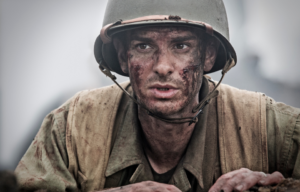
Desmond Doss displayed extraordinary courage during World War II, rescuing 75 wounded soldiers without carrying a weapon. His actions atop Hacksaw Ridge—a steep and heavily fortified escarpment on Okinawa—have made the site an enduring symbol of bravery, moral conviction, and selfless service under fire.
Hacksaw Ridge formed part of the brutal fighting during the Battle of Okinawa, one of the bloodiest campaigns of the Pacific War. The position was fiercely defended by Japanese forces, and American troops faced intense resistance as they fought to secure the strategic high ground. Combat unfolded across rugged cliffs, fortified cave systems, and exposed terrain, with heavy casualties on both sides.
The story of Hacksaw Ridge remains inseparable from Doss’s actions there. Serving as a combat medic, he repeatedly entered the battlefield under enemy fire to treat and evacuate wounded men, lowering them one by one down the cliff face to safety. His unwavering commitment to saving lives without taking them earned him the Medal of Honor, making his service one of the most remarkable acts of heroism in American military history.
Battle of Okinawa

Desmond Doss’ courageous actions unfolded during the Battle of Okinawa. Officially known as Operation Iceberg, it was a major engagement between the US military and the Imperial Japanese Army (IJA). On April 1, 1945, the American forces launched the largest amphibious assault in the Pacific Theater of World War II by landing on the island.
The campaign extended from April 1 to June 22, 1945, with the primary objective being to seize control of Okinawa’s key air base, intending to utilize it as a strategic launching point for the planned invasion of Japan. Amid the challenging terrain, US troops engaged in fierce combat with the Japanese forces, capturing various fortified positions, including the Maeda Escarpment, better known as Hacksaw Ridge.
Where is Hacksaw Ridge?

How did Hacksaw Ridge get its name?

The name “Hacksaw Ridge” is believed to have originated from the steep, jagged escarpment at the heart of the fighting, though the precise reason U.S. troops began calling it that remains unclear. Several theories exist. One theory ties the name to the landscape itself—specifically, the northern face of the escarpment, where two distinct rock formations, known as Hacksaw Ridge and Needle Rock, are divided by a gap that some say resembles the serrated edge of a hacksaw blade.
Another interpretation leans more metaphorical. In this view, “Hacksaw” reflects the brutal, grinding nature of the battle. The term evokes the relentless push and pull of combat, with the “teeth” of the hacksaw symbolizing the many lives cut down in the ferocious struggle for control of the ridge.
Desmond Doss

Hacksaw Ridge can’t be discussed without highlighting the remarkable heroism of Desmond Doss. Raised as a Seventh-day Adventist, Doss was deeply committed to non-violence and held strong religious beliefs that guided his actions. When World War II broke out, he was working in a shipyard but chose to leave that job to enlist in the U.S. military.
Despite volunteering to serve, Doss refused to carry a weapon or harm another person, staying true to his convictions. Instead, he became an Army medic with the 2nd Platoon, Company B, 1st Battalion, 307th Infantry Regiment, 77th Infantry Division.
Doss first saw combat in 1944 during campaigns in Guam and the Philippines, where he quickly earned a reputation for extraordinary bravery in rescuing wounded soldiers under fire. Before ever setting foot on Hacksaw Ridge, he had already been awarded two Bronze Star Medals with a “V” device for valor.
The valiant efforts of Desmond Doss

When Desmond Doss was sent to Okinawa, he found himself braving the deadly Hacksaw Ridge. He made the climb alongside the others, tending to the wounded as they went. Eventually, the casualties were so bad that the Americans were ordered to retreat.
Instead of following orders, Doss decided he was going to save as many wounded men as possible. He ran into the killing zone, carried his injured comrades to the edge of the cliff and lowered them to the bottom, where other medics stood waiting for them. He repeated this process numerous times, praying as he went, “Lord, please help me get one more.”
More from us: Eddie Slovik: The Only US Soldier to Be Executed for Desertion Since the Civil War
By the time Doss had done all he could, he’d saved 75 men, although his comrades swear it was more like 100. He continued to serve in Okinawa until May 21, 1945, when he was evacuated after being wounded. Later that same year, he was awarded the Medal of Honor for his actions.