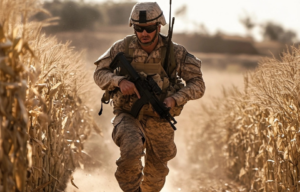
The Victoria Cross stands as the United Kingdom’s most prestigious military decoration, awarded only to those who demonstrate exceptional valor in combat. Tragically, many recipients are honored posthumously, as their heroic deeds often cost them their lives. One such individual was Cpl. Bryan Budd, who lost his life leading a daring solo assault under intense Taliban fire.
With just five days left before his scheduled return home, most would have been focused on seeing their loved ones again. Budd, however, put the safety of his comrades above his own, using his bravery to protect them and ultimately sacrificing himself in the process. In those final moments, he exemplified the courage and commitment that define the British Parachute Regiment.
His story serves as a poignant reminder to honor those who give everything for others—a testament to the extraordinary individuals whose presence enriches and inspires us all.
Bryan Budd was a professional soldier

Bryan Budd was born in Belfast, Northern Ireland, in 1977, and from a young age, he dreamed of becoming a soldier. In 1996, he began his journey toward this goal by enlisting in the Parachute Regiment, determined to serve with one of the military’s elite units on the front lines of battle.
Budd’s ambition didn’t stop there. He went on to pass the difficult selection process for the Pathfinder Platoon of the 16 Air Assault Brigade. This elite unit, specializing in reconnaissance missions deep within enemy territory, allowed him to play a key role in many combat operations across the former Yugoslavia, Sierra Leone, Macedonia, Iraq and, ultimately, Afghanistan.
Increased Taliban activity in Helmand province

In 2006, Bryan Budd joined the 3rd Battalion, Parachute Regiment (3 PARA) as part of a British task force sent to Helmand province in Afghanistan. At that time, this region was a focal point of the war’s most intense combat, especially near the town of Sangin.
The Taliban, having grown more familiar with Western military strategies, had adapted their tactics to become a more resilient and formidable adversary. Whereas they had previously preferred engaging from a distance, they were now willing to confront their opponents up close, vying for control of Afghanistan’s rural areas.
For Budd’s final engagement, this shift meant fighting within mere meters in a cornfield with stalks reaching head-high.
His Victoria Cross citation details two notable events, the first of which occurred on July 27, 2006. When his section came under heavy fire from multiple Taliban fighters on a rooftop, several British PARAs were wounded and needed evacuation. Realizing the suppressive fire was preventing this, Budd rose to his feet, fully exposed to intense gunfire, and charged toward the building.
Budd’s charge forced the Taliban to retreat across an open field, where they met British PARA marksmanship. His actions facilitated his comrades’ evacuation and marked the first of two remarkably heroic acts.
Bryan Budd was just five days from home

Bryan Budd was expected to return home on August 25, 2006, although military deployment timelines can change unexpectedly. Five days earlier, on August 20, he was assigned to defend a remote outpost in Sangin. Because of its isolated location, the position faced frequent Taliban attacks, making continuous alertness and routine patrols essential.
While leading one of these patrols, Budd guided his men through tall, densely packed cornfields. Even with visibility badly limited, he noticed a large Taliban force approximately 30 meters in front of them. Seeking to gain the upper hand, he decided to move his patrol around the enemy in an attempt to carry out a surprise attack from the flank.
Before the plan could be executed, however, the Taliban became aware of the patrol’s presence, and an intense firefight quickly erupted.
Taliban insurgents versus the British Parachute Regiment

With three members of his unit wounded, Bryan Budd again understood that he needed to seize the attack back. This time, he advanced on his own, charging through the corn and attacking the enemy position. Although he was wounded during the exchange of fire, Budd kept moving forward, allowing the rest of his men the protection and time they needed to regroup.
His attack suppressed the Taliban fighters and made it possible for the wounded soldiers to be evacuated.
When the unit pulled back, however, Budd was nowhere to be found. He was initially declared missing in action (MIA), and a quick reaction force was organized to locate him. Supported by air power that held back the Taliban, the force fought its way through the vegetation. Budd was eventually found dead in the field, alongside the bodies of three insurgents.
Bryan Budd met a tragic end

For his actions on August 20, 2006, and a few days prior, Bryan Budd was awarded the Victoria Cross. He was one of less than 20 to receive the honor since the end of the Second World War. A subsequent examination might have proven that the fatal shot came from a 5.56 mm NATO weapon, which indicated friendly fire. However, that only occurred because he saw fit to close in and destroy the enemy.
On not one, but two occasions, Budd deemed it advisable to launch a counterattack and gift violence to the enemy, rather than receive it. An unexpected counterattack disrupts enemy momentum, but often at a great cost to those who pursue it. Budd will rest in the hall of history that recognizes him as a warrior who understood that battle is fought one moment at a time, with little disregard for when you might be going home.
More from us: James Ashworth: The Victoria Cross Recipient Who Gave His Life to Take Out An Enemy Sniper
If it’s indeed the case that Bryan Budd would have returned home with his family in just five days, then history owes him the recognition for conducting such a feat and sacrificing his life for his comrades.