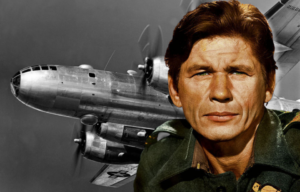
Charles Bronson was awarded a Purple Heart for his service as an aerial gunner during World War II

Photo Credit: 1. Keystone-France / Gamma-Keystone / Getty Images 2. Esamuel / Metro-Goldwyn-Mayer / United Artists / MovieStillsDB

Charles Bronson earned a reputation as one of Hollywood’s most iconic tough-guy actors, a persona rooted not only in his film career but also in the hardships he endured early in life. Raised in a coal-mining community in Pennsylvania, Bronson spent part of his youth working in the mines to help support his large family. The physically demanding environment and difficult living conditions helped forge the resilience and ruggedness that later became central to his screen image.

That toughness was reinforced by his military service during World War II. Bronson enlisted in the United States Army Air Forces and served as an aerial gunner aboard Boeing B-29 Superfortress bombers. Flying combat missions over hostile territory exposed him directly to the dangers of war, experiences that later lent authenticity and credibility to the hard-edged characters he portrayed on screen.

Early life in the coal mines of Pennsylvania

Portrait of Charles Bronson
Charles Bronson, 1974. (Photo Credit: Bettmann / Getty Images)

Born Charles Dennis Buchinsky on November 3, 1921, Charles Bronson grew up in a Lithuanian-American Catholic family as the eleventh of 15 siblings. His childhood was marked by severe poverty, and Lithuanian was the only language he spoke during his earliest years. He later became proficient in English, Russian, and Greek.

The family’s already precarious financial situation worsened when Bronson lost his father at the age of ten. During his teenage years in Pennsylvania, he began working in coal mines to help support his brothers and sisters, reportedly earning approximately one dollar per ton of coal extracted. The physically exhausting labor and harsh working environment helped shape the grit, persistence, and strength of character that would eventually define his public image and establish him as one of Hollywood’s most famously tough actors.

Entering the US Army Air Forces (USAAF)

Boeing B-29 Superfortress in flight
Boeing B-29 Superfortress. (Photo Credit: US Air Force / Wikimedia Commons / Public Domain)

In 1943, after spending 12 years working in the coal mines, Charles Bronson enlisted in the U.S. Army Air Forces.

He started his military service with the 760th Flexible Gunnery Training Squadron before moving on to become an aerial gunner on a Boeing B-29 Superfortress. Assigned to the 61st Bombardment Squadron, 39th Bombardment Group in Guam, Bronson flew 25 combat missions over Japan, many of them extremely dangerous.

During one of these missions, he was wounded in the arms and later awarded the Purple Heart for his injuries in combat. He completed his three years of service in 1946.

Charles Bronson adapted well to military life

Still from 'The Great Escape'
The Great Escape, 1963. (Photo Credit: andrewz / MovieStillsDB)

Though many found the standards of military life challenging, Charles Bronson viewed them as indulgent, saying, “I never had it so good as when I entered the Army. Men were complaining around me. But I was eating and sleeping well, and I thought: ‘Jeez! This is great!’ For me, being drafted was like having a fairy godfather change me into a prince.”

After Bronson achieved fame as a Hollywood star, a genuine rags-to-riches story, news sources scrutinized his military background. Some suggested he had only served as a delivery truck driver for the 760th Mess Squadron in Arizona. However, his World War II comrades confirmed he served as a nose gunner on a B-29.

Additionally, records have been found confirming his service in Guam as a B-29 crew member, including a September 1945 roster from the 61st Squadron that lists his name.

Post-World War II

Charles Bronson as Rodolfo Fierro in 'Villa Rides'
Villa Rides, 1968. (Photo Credit: Silver Screen Collection / Getty Images)

After serving in World War II, Charles Bronson used his GI Bill benefits to pursue a new path in the arts, enrolling at the Pasadena Playhouse in sunny California. But success didn’t come overnight. He struggled to land roles and scraped by doing odd jobs, even sharing an apartment with fellow aspiring actor Jack Klugman as they both chased their Hollywood dreams.

In the beginning, Bronson appeared in small, often uncredited roles under his birth name, Charles Buchinsky. His first breakout came in 1953’s House of Wax, where he portrayed the sinister Igor—a performance that finally got him noticed by casting agents and studios.

But just as his career began to pick up, a new challenge emerged: politics. After a number of Soviet spies were uncovered in seemingly secure positions, the nation began actively pursuing and halting Communist activities. During the height of the Second Red Scare, when fear of Communist influence was sweeping the country, Bronson realized his Slavic-sounding surname might attract unwanted scrutiny from the House Un-American Activities Committee (HUAC). So, in 1954, he made a pivotal decision—he changed his name to “Charles Bronson,” a move that helped him avoid political backlash and launch the next phase of his career.

Charles Bronson’s career eventually gained steam

Still from 'Once Upon a Time in the West'
Once Upon a Time in the West, 1968. (Photo Credit: hilts / MovieStillsDB)

Charles Bronson’s rise in Hollywood began during the 1950s, leading him to rank among the highest-earning performers of the 1970s by securing $1 million for each film. He delivered his most famous roles in well-known films like The Great Escape (1963), Once Upon a Time in the West (1968), and Death Wish (1974), acting alongside legendary figures like Steve McQueen and Henry Fonda.

Despite his massive success, he remained haunted by his past. Having endured time in suffocating coal mines during his youth and confined bomber aircraft while serving in the military, Bronson lived with severe claustrophobia. He closed out his screen career playing Paul Fein in the three-part Family of Cops television movie series.

After undergoing a hip replacement, Bronson retired from acting due to declining health. He passed away in 2003 at 81 years old and was buried at Brownsville Cemetery located in West Windsor, Vermont.

Jesse Beckett

Jesse is a U.K.-based writer for Tank Roar, passionate about military history and storytelling through digital content. With a special focus on tanks and ships, Jesse brings a deep enthusiasm for historical narratives to every piece.